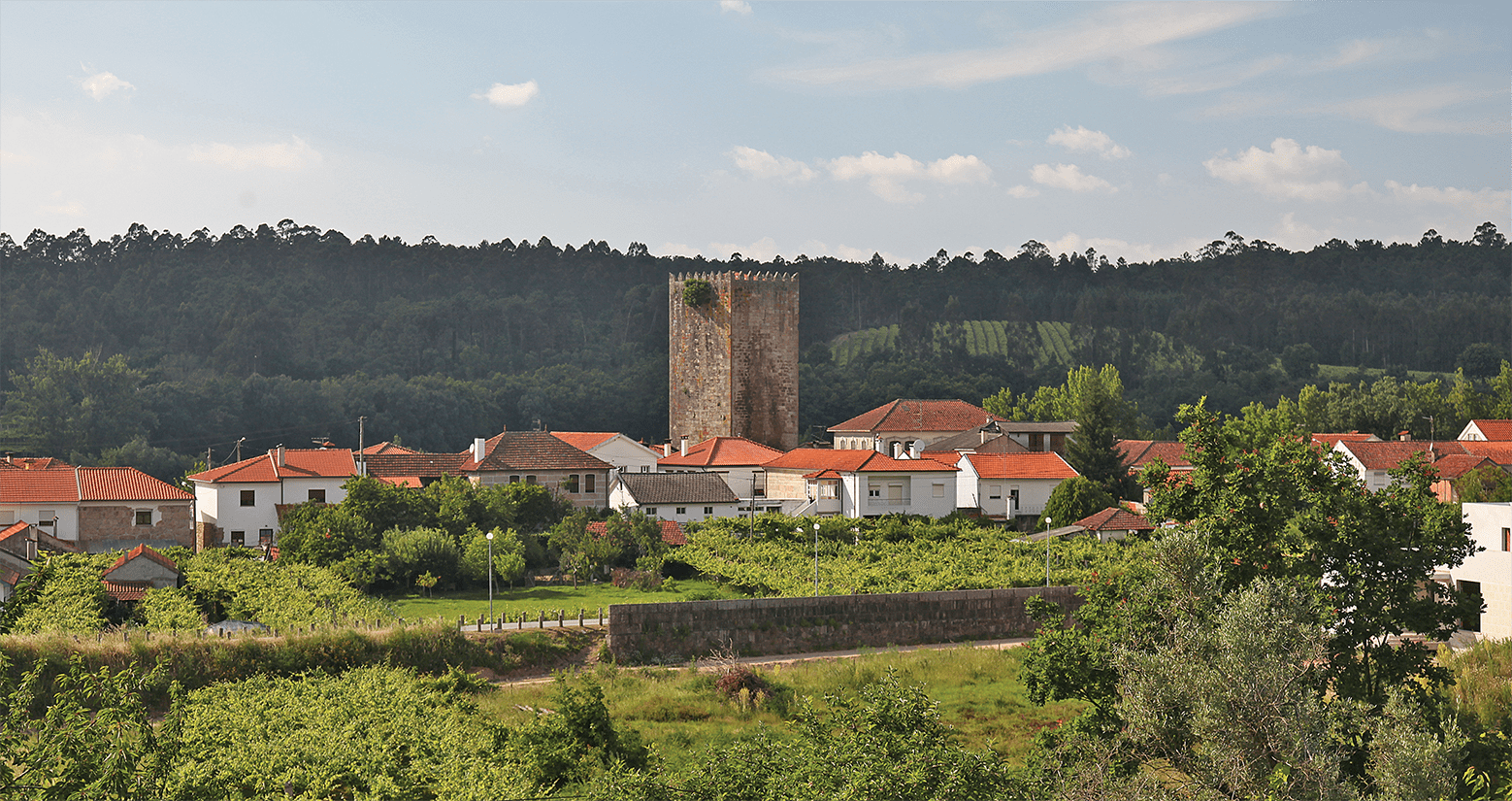
There are places in Portugal that feel untouched by time. Torre de Lapela is one of them. Rising like a granite sentinel above the slow, green waters of the River Minho, the tower is all that remains of a medieval fortress that once protected the frontier town of Monção. Today it stands quiet, its walls weathered by centuries of rain and sun, its battlements staring across to Galicia, Spain.
It’s not a castle polished for postcards. It’s rough, solitary, and beautifully authentic, the kind of place where imagination still has room to roam.
“Standing on its ramparts, you can hear the hush of the Minho and feel history pressing close, as if the stones themselves remember the weight of swords.”
The Story of a Border Tower
A Frontier Written in Stone
The Minho River has always been more than water. It has been a border, a meeting place, and a line of defense. In the late 13th and early 14th centuries, Portugal’s kings were determined to secure their northern border against Castile.
King Dinis, the “Farmer King,” known for planting forests and strengthening Portugal’s defenses, ordered the construction of fortifications all along the Minho. Torre de Lapela was one of these.
The tower rises nearly 30 meters high, built of massive granite blocks quarried nearby. Originally, it formed part of a walled fortress enclosing the settlement of Lapela. The walls have been dismantled stone by stone over centuries, leaving only the tower standing as a monolith of memory.
War, Wine, and Watchfulness
The 14th and 15th centuries were turbulent. The Minho frontier was the stage for raids, counter-raids, and uneasy truces.
- Military Use: The tower’s height made it perfect for signalling and surveillance. Fires lit atop it could carry warnings along the river valley.
- Civil Use: During quieter times, it became a place of storage and authority, where taxes were collected and disputes settled.
- Symbolic Use: For locals, it stood as a symbol of Portuguese sovereignty, a reassurance that the crown had not forgotten the borderlands.
By the 16th century, peace had taken a firmer hold, thanks to stronger dynastic ties between Portugal and Spain. The need for constant vigilance faded. The fortress was dismantled, but the tower was left standing, partly as a landmark, partly as an enduring watchtower over the Minho.
Architecture That Speaks of Power
The Torre de Lapela is a classic medieval keep: square in plan, with massively thick walls and minimal decoration. Its simplicity is its strength.
- Height: ~30 meters, one of the tallest surviving medieval towers in Portugal.
- Walls: Almost 3 meters thick at the base.
- Arrow slits: Narrow windows that allowed defenders to fire arrows or crossbow bolts.
- Machicolations: Traces of stone projections at the top where defenders could drop rocks or boiling oil on attackers.
The interior would once have been divided into several timber-floored levels: storage at the bottom, living and guard quarters above, and a rooftop platform for watch duty.
Today, visitors may not always be able to climb inside (access varies with restoration and safety works), but the sheer presence of the tower, standing stark against the sky, is enough to stir the imagination.

The Landscape Around the Tower
River Minho: A Living Border
The Minho is wide here, flowing broad and steady. On its far bank lies Salvaterra de Miño, a Galician town with its own fortress, directly facing Monção. The two communities spent centuries eyeing one another warily across the water. Today, they’re linked by cooperation, culture, and even festivals.
Vineyards of Alvarinho
This region is also the homeland of Alvarinho, the celebrated Vinho Verde white wine. To visit Torre de Lapela is to step into the heart of wine country, where terraces of vines climb the slopes and every meal seems to come with a chilled glass of crisp, floral Alvarinho.
The Atmosphere of Seclusion
Unlike Braga or Guimarães, Torre de Lapela is rarely busy. It’s off the main tourist trail, tucked into a quiet riverside village. This solitude is its gift: you can wander in silence, linger by the water, and feel as though you’ve stepped back into a slower, older rhythm.
“At Torre de Lapela, history doesn’t shout; it whispers, carried on the breeze that crosses the Minho.”
Legends and Local Memory
Like many border fortresses, Torre de Lapela has gathered its share of stories:
- The Silent Watcher: Locals say the tower was never fully abandoned, that on stormy nights, a spectral guard still paces the roof, keeping watch over the frontier.
- Hidden Treasure: Folklore whispers of gold hidden in its foundations, buried during one of the many wars with Castile.
- Cross-Border Rivalry: Elders tell of times when villagers would light lanterns atop the tower to “answer” the lights of Salvaterra’s fortress across the river, part competition, part communication.
These legends add color to the otherwise austere stones, reminding us that towers are never just walls: they’re vessels of imagination.

How to Visit Torre de Lapela
Location: Village of Lapela, about 4 km from Monção, Viana do Castelo District.
Opening Hours:
- The exterior is always visible.
- Interior access varies; check with the Monção tourist office for the latest updates.
Entry Fee: Usually free or symbolic.
Getting There:
- By Car: From Porto, take the A3 freeway north towards Valença. Exit near Monção. Approx. 1h30.
- By Train/Bus: Trains reach Valença; buses connect to Monção. From Monção, it’s a short taxi ride.
- By Bicycle: The Ecopista do Rio Minho, a green cycling trail built on an old railway, passes nearby and offers one of the most scenic approaches to the tower.

What to Do Nearby
- Monção Town: Explore cobbled lanes, the walls of Monção Castle, and the town’s thermal spa.
- Alvarinho Wine Route: Visit quintas (wine estates) like Soalheiro or Quinta de Alderiz. Tastings are a highlight.
- River Walks: The Minho’s banks are perfect for long walks or cycling along the ecopista.
- Cross to Galicia: A bridge links Monção with Salvaterra de Miño. Spain is just minutes away.
- Festivals: If you visit in summer, look for the Feira do Alvarinho, a lively celebration of wine, music, and culture.
Practical Travel Tips
- Best time to visit: Spring and autumn, when the weather is mild and the vineyards are at their most beautiful.
- Bring: Comfortable shoes, a camera, and time to linger.
- Combine with: A day trip through the Minho Valley, including Valença, Caminha, and even the Atlantic coast.
“If Monção is the beating heart of Alvarinho wine country, Torre de Lapela is its unblinking eye, watching the river, the vines, and the centuries pass.”