


| Builder and General characteristics | Viana do Castelo Naval Shipyards Tonnage 3467 gt Length 322.99 feet (98.45 m) Beam 45.00 feet (13.72 m) Draught 7.87 feet (2.40 m) Propulsion 2 engines of 1,400 bhp (1,000 kW) each Speed 12.5 knots (23.2 km/h; 14.4 mph) |
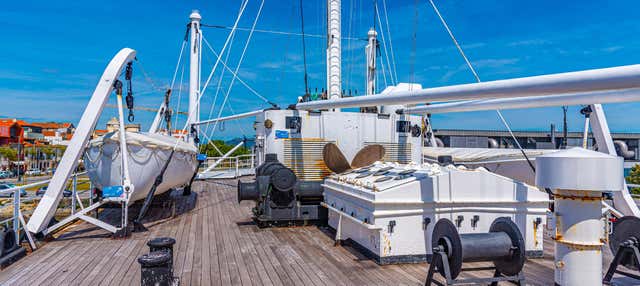
Here’s a detailed look at the Gil Eannes — its story, its role and why it’s interesting to visit.
1. Origins & Construction
- The ship we’re talking about was launched in 1955 at the shipyard in Viana do Castelo, Portugal.
- It was built to replace an earlier vessel (also named Gil Eannes) that had been supporting the Portuguese fishing fleet.
- Its design: about 98.45 m long, 13.72 m wide, 5.49 m draft. Motorised by two Fairbanks-Morse diesel engines (~2 × 1400 hp) giving a speed around 12.5 knots.
- It was built as a multi-role ship: hospital ship, supply vessel, icebreaker, tug, mail ship, flagship for the fishing fleet.
2. Its Role & Service
- Between 1955 and 1973 the Gil Eannes operated with the Portuguese “White Fleet” (fishing for cod around Newfoundland and Greenland).
- While its primary function was as a hospital ship (treatment rooms, radiology, operating theatre) it also: delivered supplies (food, fuel, bait), acted as ice-breaker, tug, mail ship, maritime authority for the fleet.
- In 1963 it began to do some passenger and refrigerated-cargo work during off-season.
- The last voyage supporting the cod-fishing fleet to Newfoundland was in 1973. After that it lost its original role.
3. Decline, Rescue & Museum Conversion
- After 1973 it was decommissioned, anchored in Lisbon, and looked set for scrap.
- In 1997/98 a campaign succeeded in saving the ship. In 1998 the vessel was restored in Viana do Castelo.
- Today it is permanently moored in the fishing harbour of Viana do Castelo and functions as a museum ship and a youth hostel (in the former wards) under the management of Fundação Gil Eannes.
4. Why It’s Interesting to Visit
- It’s a rare example of a ship that combined hospital/medical services with support for a large-scale fishing operation in harsh North Atlantic conditions.
- Visiting gives you a feel for the scale and complexity of Portuguese maritime fishing in the 20th century: the ship’s engine room, treatment rooms, bridge, supply decks.
- It also offers insight into social history: the lives of fishermen, the support infrastructure they had, the maritime heritage of Portugal.
- From a travel-perspective: located in Viana do Castelo, at the waterfront, so it’s also a nice stop when exploring that region of Portugal.
5. Practical Info
Note: there are steep ladders and stairs inside the ship, so mobility may be an issue for some visitors.
Location: Doca Comercial, Viana do Castelo, Portugal.
The museum part of the ship has a modest entry fee; there is also a free “Centro do Mar” section.


