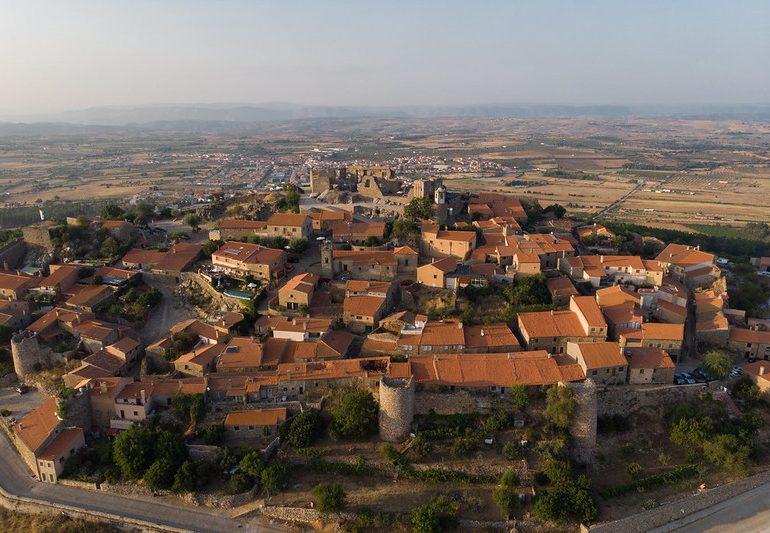
Idanha-a-Velha (Idanha “the old”), one of Portugal’s oldest towns, has been characterized as a “tiny village with a rich historical past.” Idanha-a-Velha is constructed on the ruins of the city of Egitânia, which formerly numbered in the thousands. The town has been continuously attacked and plundered throughout history, and the remains bear witness to the impact of many eras: structures from the Pre-History, Celtic, Classic Roman, Suebic, Visigothic, Moorish, Medieval, and Portuguese Manueline periods.
The village is said to have been the birthplace of both the renowned Visigothic King Wamba and fourth-century Saint Pope Damasus. Roderic, the Visigoth king, is also believed to be buried here.
The town is home to a rebuilt 16th-century church known as “the Cathedral,” constructed on Suebi remains going all the way back to the fourth century – the Iberian Peninsula’s earliest Visigothic cathedral.
The greatest collection of Roman epigraphs in Europe is located near the cathedral, in an old structure that has been renovated into a contemporary museum to house the carved and engraved Roman stones. Idanha-a-Roman Velha’s epigraphic collection is one of the most extensive and representative in Portugal. It was produced throughout various stages of the village’s archaeological research. It is situated on the grounds of the village’s ancient olive press in the village’s south-eastern section and was established to house the collection, which was formerly housed at Santa Maria Church or the Cathedral.
The new museum initiative enabled the research and publication of this significant collection, as well as the organization of the exhibition Verba Volant, Scripta Manent (words fly but writing endures). 86 of the 210 works are on view, combining conventional exhibition methods with multimedia technologies. Due to the scientific correctness of the contents, it was essential to provide effective access to them to a broad audience, and so an interactive display was created in which technology-assisted in contextualizing and interpreting the pieces. This project promotes the utilization of local history via scientific study, archaeological preservation, and the use of modern technologies in order to fulfil the requirements of qualified tourism in the area.
Additionally, the town square has a 17th-century pillory. The remains of a Torre dos Templários, a tower built on the foundations of a Roman temple dedicated to Venus, are nearby. From 1900 until the early 1930s, it was a part of the civil parish of Alcafozes. In 2013, the civil parish of Idanha-a-Velha united with the parish of Monsanto e Idanha-a-Velha to become the new parish of Monsanto e Idanha-a-Velha.