



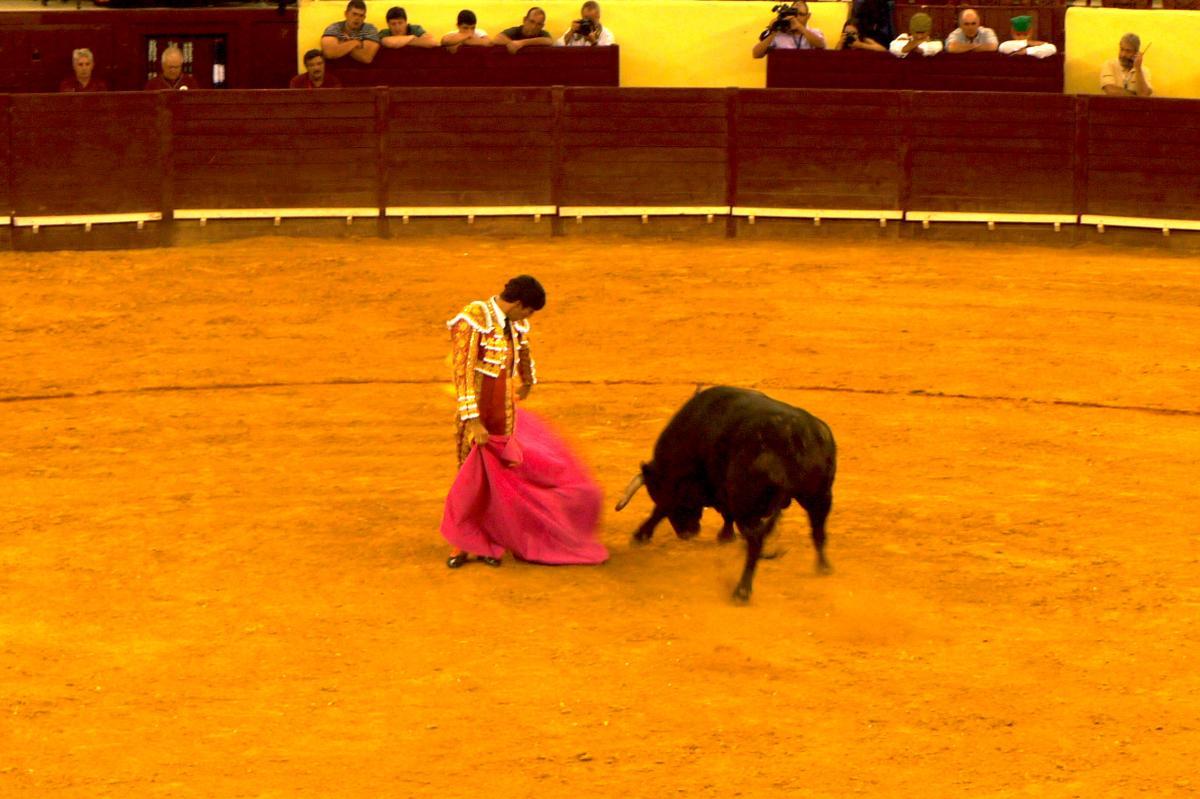
Regardless of your personal feelings towards bullfighting, it is undeniable that the “sport” remains important to Portuguese culture, despite several activist groups’ repeated calls for its abolition. A variety of disciplines, extravagant costumes, and coordinated routines are all part of the Portuguese show.

Many people are unaware that Portuguese bullfighting differs significantly from the more usually observed Spanish-style. Most significantly, the matador does not slaughter the bull in front of the audience (and has not done so since the mid-nineteenth century). Furthermore, cavaleiros (horsemen/women) and forcados (weaponless bull wrestlers) have always played a role in the show, but these disciplines do not exist in the Spanish bullring at all.
Bandarilheiros, who use capes, calls, and other attention-grabbing techniques to distract the bull and shift him to different areas of the ring, is also used in the Portuguese bullring. They wear a gold/pink cape and a dazzling suit, but never with gold sequins.

The cavaleiros are horseback riders who are typically outfitted in period attire from the eighteenth century. Their objective is to entice the bull to charge and then get near enough to insert a single dart, or bandarilha, into the bull’s back muscle. A good “stick” is one that keeps the dart lodged. If it falls out, the attempt is deemed a failure. These cavaleiros ride magnificent Lusitano horses that have been carefully trained for the bouts, and their moves are not only daring but aesthetic. Additionally, this breed of horse has a lengthy history of victorious battles in Asia, Africa, and Southern Portugal.

There are many styles of traditional bullfighting in Portugal, some of which are quite distinct from the one described above. Bullfighting in the Azores is frequently compared to the running of the bulls in Pamplona, Spain, in that those most at risk are human people, not the bulls themselves. The Azorean technique entails a group of people competing in a tug-of-war with a young bull while clinging to a long, sturdy rope looped around the bull’s neck. This is referred to as the tourada à corda (‘game’ of a bull on a rope).


An 18th-century basilica on a rocky outcrop with sweeping views of the surrounding valleys & mountains.
Sanctuary of Nossa Senhora da Piedade
The Feast of the Patron Saint takes place here on Ascension Sunday.
The Sanctuary of Nossa Senhora da Piedade is located 48 kilometres from Belo Horizonte and 16 kilometres from the city of Caeté. It is the best spot for meditation, prayer, and meeting with God because it is built on top of the mountain at an elevation of 1746 metres. The Sanctuary, which houses the patron saint of Minas Gerais, is ideal for visitors seeking peace and natural beauty. Every moment in this region of breathtaking beauty is worth capturing. Always keep a camera handy.