A white village of flowers, memory, and quiet dignity
There are places that arrive loudly. And then there are places like Castelo de Vide, which don’t announce themselves at all. You notice them slowly. First the air changes. Then the light softens. Then, somewhere between the bend in the road and the first glimpse of whitewashed houses climbing the hill, your shoulders drop. You start walking slower without deciding to.
Castelo de Vide sits in the Alto Alentejo, close to the Spanish border, tucked against the Serra de São Mamede. It is often called the Sintra of Alentejo, though that comparison only goes so far. Sintra performs. Castelo de Vide simply exists. It doesn’t need your approval. It has been itself for a very long time.
This is a village built of restraint. White walls, dark trim, granite steps worn smooth by centuries of footsteps. Flowers everywhere, not as decoration, but as habit. The kind of place where beauty is not curated. It’s maintained, quietly, daily, without fuss.
What follows is not a checklist or a highlights reel. It’s a walk. A slow one. Through streets, stories, silences, and the kind of details that don’t fit neatly into travel brochures but stay with you long after you leave.
The first impression: white on white, softened by time
Castelo de Vide is often described as one of the whitest villages in Portugal. That’s true, but incomplete. The white here isn’t blinding. It’s softened by age, by dust, by weather, by flowers leaning over walls and windows. It’s white that has lived.
The houses climb the hill organically, without symmetry or grand planning. Streets curve because they always have. Steps appear where carts once needed help. Doorways sit low. Windows are small. Nothing shouts.
As you walk upward, the village reveals itself in layers. A fountain here. A tiled niche there. A sudden opening that frames the countryside beyond, green and folded, stretching toward Spain. The rhythm of the place encourages pauses. You stop often, not because there’s something to see, but because there’s something to feel.
Flowers as language
Castelo de Vide is famous for its flowers, and deservedly so. Geraniums spill from balconies. Bougainvillea climbs walls. Pots line staircases like punctuation marks.
But what’s striking is not abundance. It’s care.
Each pot is watered. Each plant tended. Even the most modest homes participate. Flowers here are not a tourist flourish. They are part of how people relate to their village. A quiet agreement between neighbours. A shared responsibility to beauty.
This matters, because it tells you something essential about Castelo de Vide. This is not a place that gave up when time moved on. It adapted, gently, without losing itself.
The castle above everything
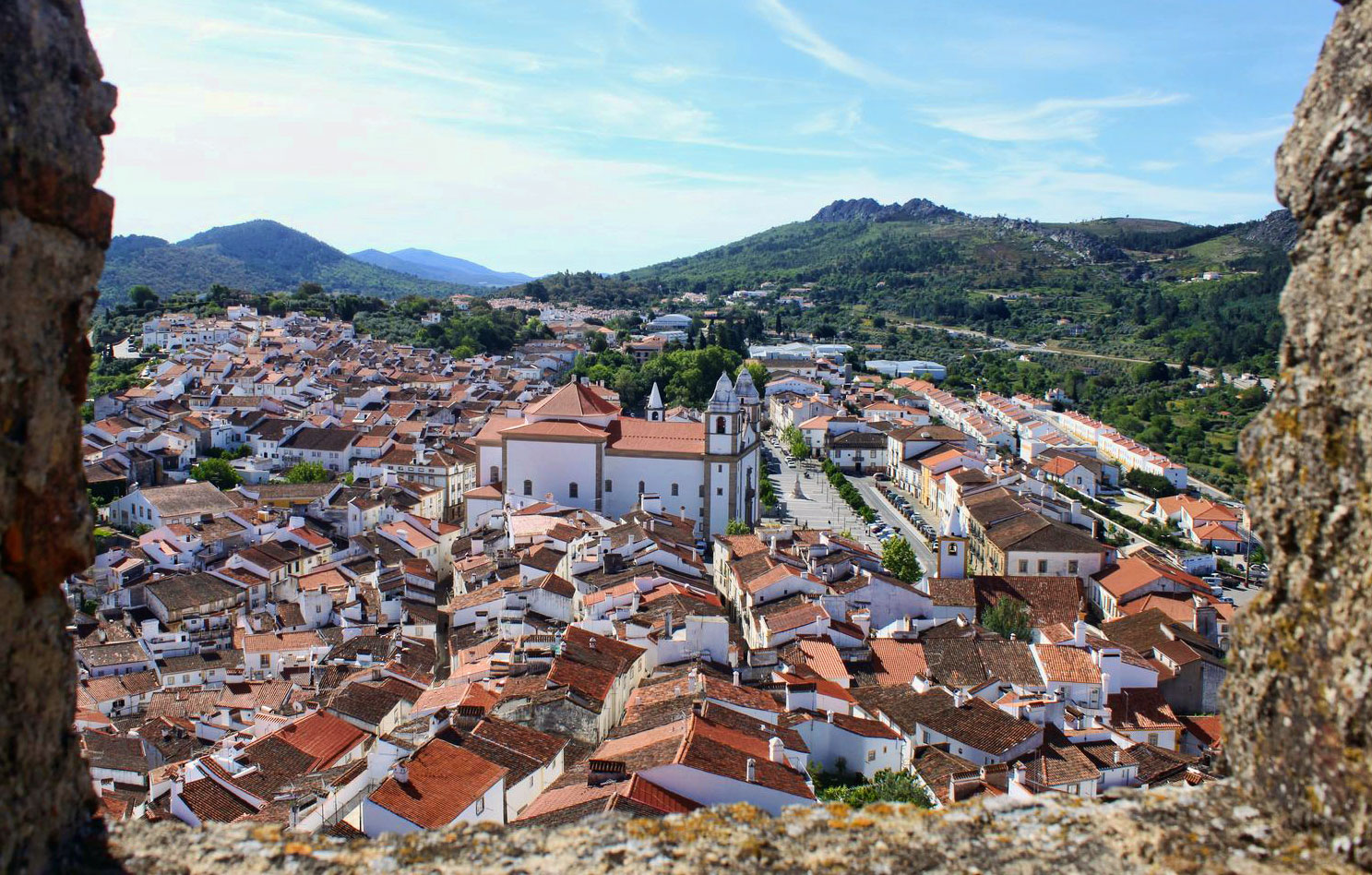

Above the village, the castle watches. Not dramatically. Not defensively anymore. It’s there like an old memory that hasn’t been erased.
The Castelo de Vide castle dates back to the 13th century, expanded and reinforced over time as Portugal secured its borders. From up here, the view explains everything. The land spreads wide and open, a patchwork of greens and browns depending on the season. This was once frontier territory. Vulnerable. Watched.
Climbing to the castle is less about conquest and more about perspective. As you ascend, the village falls away beneath you, rooftops stacking into a soft geometry of white and terracotta. The silence up here is different. Thinner. Wind moves more freely. Sounds carry further.
The castle ruins are modest compared to Portugal’s grander fortresses. And that’s precisely the point. Castelo de Vide was never about spectacle. It was about survival, continuity, and community.
Standing at the walls, you feel less like a visitor and more like a witness.
The Jewish Quarter: memory in stone


One of the most powerful parts of Castelo de Vide lies not at the top of the hill, but within its narrow, winding streets: the Judiaria, the Jewish Quarter.
This is one of the best-preserved Jewish quarters in Portugal, and one of the most quietly moving. No gates. No dramatic signage. Just streets that fold in on themselves, stone steps, and doorways marked with subtle details that reveal their history if you know how to look.
The Jewish community here dates back to the Middle Ages, flourishing particularly in the 14th and 15th centuries. These were doctors, traders, scholars. Integral members of the town. When the Portuguese Inquisition forced conversions and expulsions, many stayed as so-called New Christians, carrying their faith quietly, privately, at great risk.
The former synagogue, now a small museum, is simple and dignified. Stone benches line the walls. Hebrew inscriptions remain. It doesn’t try to overwhelm you. It doesn’t need to. The weight of history is enough.
Walking these streets, you’re reminded that beauty and suffering often coexist in the same spaces. Castelo de Vide does not erase that tension. It holds it, respectfully.
Water, always water
Castelo de Vide is known for its fountains. There are many, scattered throughout the village, each with its own character. Water has always been central here. Springs run beneath the town, feeding fountains that once supplied daily life.
The Fonte da Vila, the Fonte da Mealhada, the Fonte do Ourives. Names passed down, still used. Still relevant.
There’s something grounding about hearing water in a village like this. It anchors you. Reminds you that long before tourism, before photography, before travel writing, people came here for the same reason people still do. To live. To endure. To drink. To gather.
Sit near a fountain long enough and you’ll notice how locals interact with it. A pause. A rinse of hands. A moment of conversation. Life happening at human speed.
Serra de São Mamede: the green Alentejo


Castelo de Vide is part of the Serra de São Mamede Natural Park, and this matters more than many visitors realise. Alentejo is often imagined as dry, golden, flat. Here, it’s different.
The Serra brings altitude, rain, and a cooler climate. Oak forests, chestnut trees, green slopes. In spring, the landscape feels almost northern. In summer, it offers relief from the heat that defines much of the region.
Walking trails begin just outside the village. They don’t announce themselves loudly. No grand visitor centres. Just paths, marked modestly, inviting you out into silence.
This is walking not as activity, but as extension of being.
Food that doesn’t perform
Eating in Castelo de Vide is refreshingly untheatrical. No tasting menus. No reinvention. Just Alentejo food done properly.
Bread that matters. Olive oil that deserves attention. Soups that exist because people needed nourishment, not accolades.
You’ll find migas, açorda, pork dishes, lamb, simple grilled meats, and seasonal vegetables. Desserts often feature egg yolks, almonds, honey. Recipes passed through generations without being written down.
The best meals here feel like they belong to the place. You don’t eat them and think about the chef. You think about the land.
Wine flows quietly. Mostly regional. Often house wine. No lectures attached.
The sound of Castelo de Vide
Every place has a sound. Castelo de Vide’s is subtle.
Footsteps on stone.
Water in fountains.
A distant church bell.
Wind moving through narrow streets.
Occasionally, a voice, low, familiar.
There is very little mechanical noise. No constant hum. No rush. Silence here is not absence. It’s presence.
At night, the village becomes something else entirely. Lights are soft. Shadows deepen. The white walls glow faintly. You walk slower. Conversations drop in volume. The stars reassert themselves.
This is a place that still knows how to be dark at night.
Faith without spectacle
Churches appear throughout Castelo de Vide, but none dominate. The Igreja de Santa Maria da Devesa, just outside the old walls, is perhaps the most notable. Elegant rather than grand, it reflects a faith integrated into daily life rather than imposed upon it.
Inside, the atmosphere is cool, calm. Stone and light. No excess.
Religious processions still happen here. Festivals still matter. But they unfold for the community first, not the camera.
The pace of days
One of the hardest things for visitors is accepting Castelo de Vide’s rhythm. Or rather, lack of urgency.
Shops close. People linger. Lunch is not rushed. Conversations take priority over schedules.
This can feel uncomfortable at first, especially if you arrive with plans, lists, expectations. But if you stay long enough, something shifts. You stop trying to extract value from time and start inhabiting it.
Castelo de Vide doesn’t reward efficiency. It rewards attention.

Seasons, not spectacles
Castelo de Vide changes with the seasons, but never dramatically.
Spring brings flowers and green hills.
Summer is warm but gentler than the plains.
Autumn deepens colours, brings chestnuts.
Winter is quiet, introspective, honest.
There’s no bad time to come. Only different moods.
In winter especially, the village feels inward-looking. Fires lit. Streets emptier. A sense of endurance. If you visit then, you’re not a spectator. You’re a temporary participant.
Who Castelo de Vide is for
This is not a place for thrill-seekers or checklist travellers. It doesn’t offer adrenaline or novelty.
Castelo de Vide is for people who notice.
For walkers.
For writers.
For photographers who understand restraint.
For anyone who has grown tired of places trying too hard.
It’s for those who appreciate that history doesn’t always shout. Sometimes it whispers.
Leaving, and the quiet ache of it
When you leave Castelo de Vide, there’s no dramatic farewell. No final reveal. You simply drive away, the village receding gently behind you.
And yet, it stays.
In how you walk a little slower afterward.
In how noise feels louder than it should.
In how white walls and flowers mean something more.
Castelo de Vide doesn’t try to be unforgettable. That’s why it is.
Practical notes, lightly held
You don’t need much planning here.
Stay in town if you can. Walk everywhere.
Bring good shoes. Stone steps are unforgiving.
Come without an agenda.
Respect the quiet.
And most of all, don’t rush.
Getting There
The journey is part of the mood
Reaching Castelo de Vide is refreshingly straightforward, and quietly beautiful. This is not a place you stumble upon by accident, but neither does it require effort. You simply leave the rush behind, kilometre by kilometre.


From Lisbon
By car, Castelo de Vide is around 2.5 hours from Lisbon.
Take the A2 north, then connect to the A6 toward Elvas, exiting near Portalegre. From there, local roads guide you through rolling countryside and into the Serra de São Mamede. The final stretch slows naturally. The landscape greens. The air cools.
This is one of those drives where you stop checking the clock.
From Porto
From Porto, allow 3.5 to 4 hours by car.
Follow the A1 south, then transition east toward Portalegre and Castelo de Vide. It’s a longer journey, but an easy one, and best treated as a day that unfolds rather than a distance to be covered.
By public transport
Castelo de Vide is reachable by bus, usually via Portalegre. From Portalegre, regional buses or taxis complete the final leg.
Public transport works, but it does not rush. Connections are limited, and waiting is part of the experience. If you choose this route, arrive with patience rather than plans.
The best way to arrive
If you can, come by car. Not for convenience alone, but for freedom. The surrounding villages, walking trails, viewpoints, and quiet roads are as much part of the experience as the village itself.
Castelo de Vide reveals itself gradually. The journey mirrors the destination.
You don’t arrive here suddenly.
You ease into it.
Final thought
Castelo de Vide is not a destination that competes. It doesn’t trend. It doesn’t brand itself.
It simply continues.
And in a world obsessed with reinvention, that might be its greatest gift.