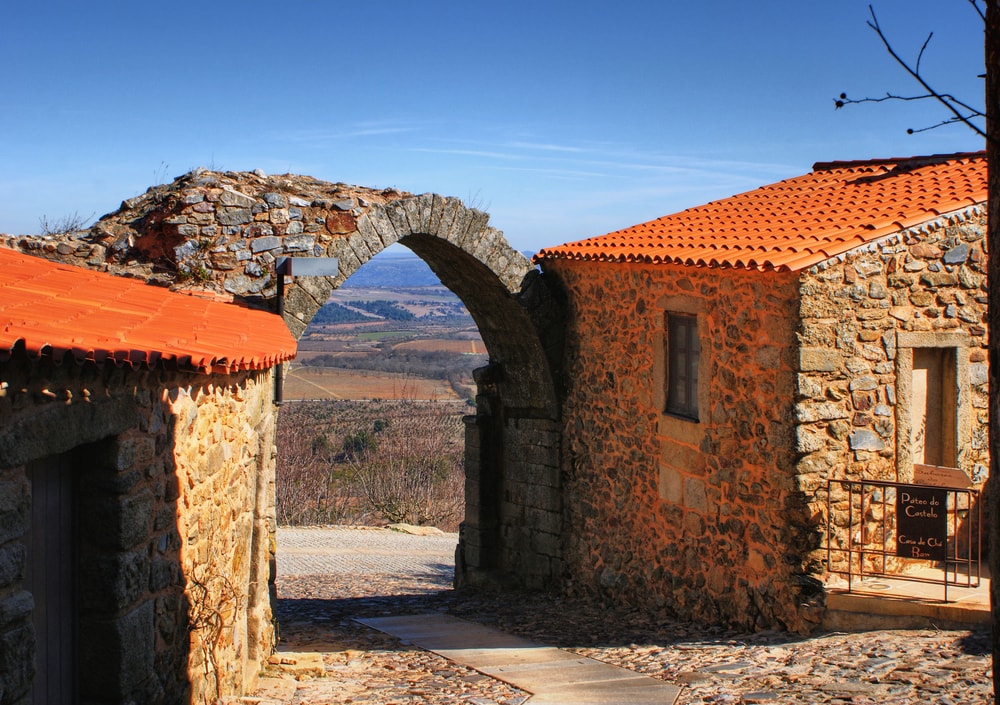
The Castle of Arnóia is a medieval castle in the civil parish of Arnóia, municipality of Celorico de Basto, the district of Braga. It is classified as a National Monument.
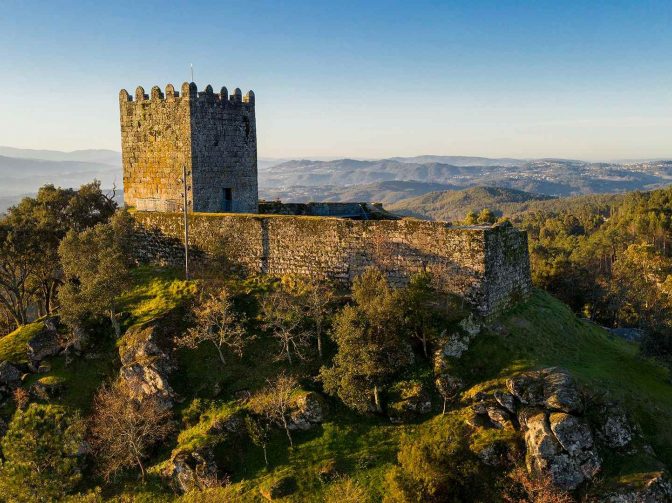
This Romanesque Castle, once located in Terra de Basto, is part of Europe’s castling movement that spanned the 10th and 12th centuries.
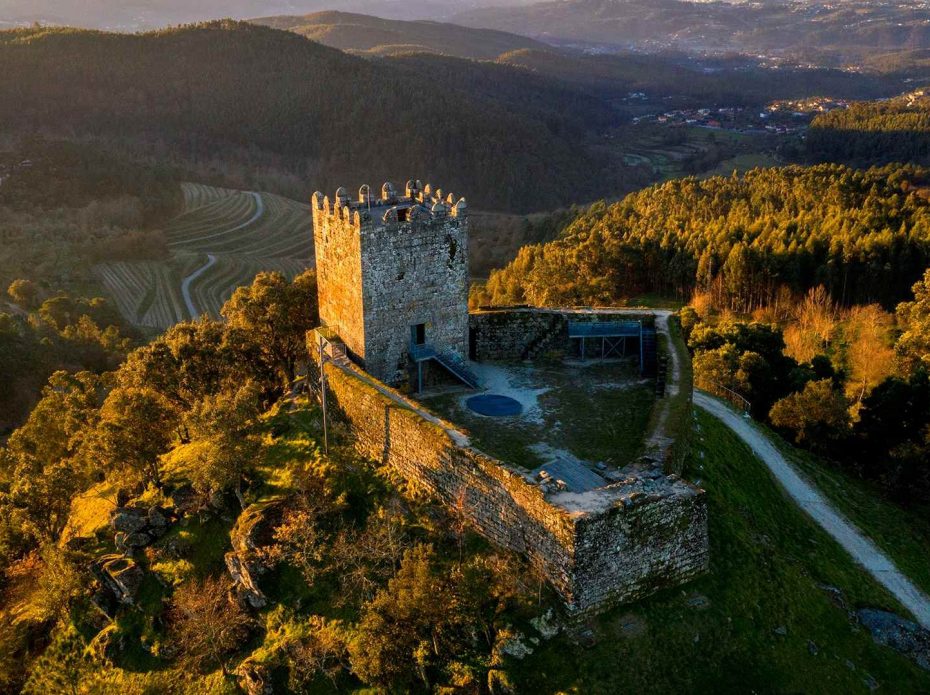
The watchtower (whose rooftop and set of battlements were restored in the twentieth century), the quadrangular tower, a single door, and the tank are the four defensive pieces that stand out on top of a hill.
Archaeological traces from the fort’s occupancy between the 14th and 16th centuries were discovered.
It is now time for the edifice to deteriorate, which in peacetime was only a symbol of administrative and lordly power that patronised the region.
The abandonment began in 1717, when the elites departed the little village of Basto, relocating the county seat to the parish of Britelo, where Celorico de Basto is now located.
The legacy of the little town of Basto lives along the branch path that connected the old road of Lixa to the main route of Amarante-Arco de Balhe, which is designated as the present-day settlement of Castelo.
The pillory, the hearing house, and the chemists are all indicative of the bustling roadway along which the village grew.
How to get here:
41.363536, -8.051996
Lugar do Castelo, Arnoia, Celorico de Basto, Braga
10th century (2nd half) – Edification of the Castle of Arnoia, according to tradition;
1064 – First documented reference regarding the fortification;
1092 – A document mentions the properties of Celorico and Terra de Basto;
12th-13th centuries – Second occupation period of the Castle and edification of the Castle of Arnoia’s Romanesque structure ;
1717 – The parish seat is transferred from Vila de Basto to the parish of Britelo;
1726 – The Terra de Basto was by then divided into two municipalities, Celorico and Cabeceiras de Basto. The Castle of Arnoia’s keep still showed its crenellation crown;
1758 – The Castle of Arnoia was already presenting some traces of ruin;
1946 – It is classified as a National Monument by Decree no. 35,532 (Governmental Gazette no. 55, from March 15th);
1960-1963 – Period of restoration works in the Castle of Arnoia, under the responsibility of the DGEMN – Direção Geral dos Edifícios e Monumentos Nacionais [General Directorate for Buildings and National Monuments];
1985 – The Castle of Arnoia is attached to the IPPC – Instituto Português do Património Cultural [Portuguese Institute of the Cultural Patrimony];
1992 – The Castle of Arnoia’s jurisdiction is transferred to the IPPAR – Instituto Português do Património Arquitetónico [Portuguese Institute of the Architectonic Patrimony];
2002 – Archaeological surveys were carried out inside the fortification;
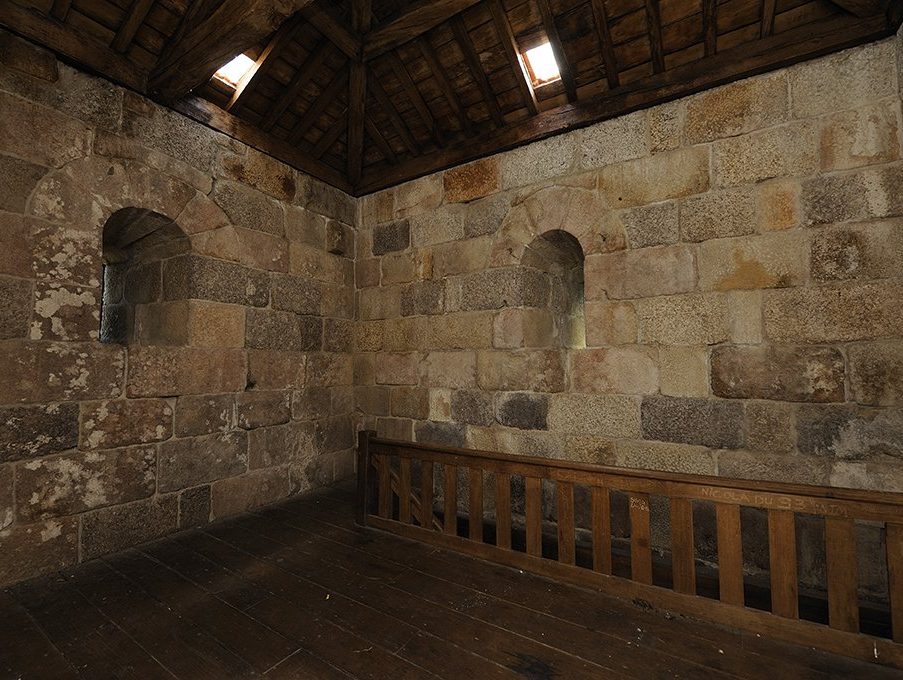
2004 – Installation of the Interpretive Centre of the Castle of Arnoia;
2005 – The Castle of Arnoia is reallocated to the IGESPAR – [Portuguese Institute for Management of Architectural and Archaeological Heritage];
2010 – Integration of the Castle of Arnoia in the Route of the Romanesque;
2014 – Improvements to the surroundings of the Castle of Arnoia, under the scope of the Route of the Romanesque;
2015 – Intervention for the conservation and protection of the inside and outside of the Castle, under the scope of the Route of the Romanesque;
2020 – The Portuguese State transfers the responsibility of management, promotion and conservation of the Castle of Arnoia to the Municipality of Celorico de Basto.
What to See and Do Around The Castle of Arnóia
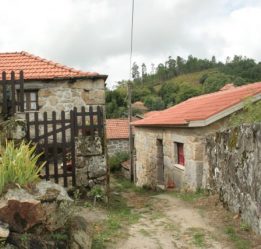
Castelo – Village
The history of this location may be imagined along the lines of its legacy, whether in the residential buildings, the House of Justice and Jail, the former pharmacy, or the pillory. The Castle, keeper of legends and stories, provides a great perspective of the village and surrounding landscape, as well as a stunning belvedere overlooking the Tâmega and Infesta valleys.
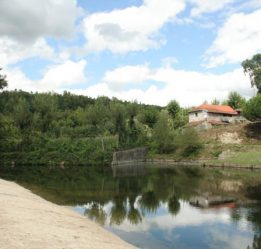
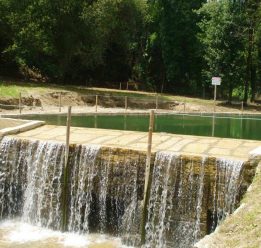
Freixo Lagoon and Leisure Park
In the summer, the Freixo Leisure Park is very popular. It has an artificial lagoon with a picnic area, a beach soccer field, and a terrace bar.
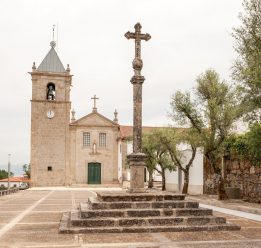
Monastery of Saint Benedict of Arnoia
A longitudinal church with a single nave and a smaller square chancel, a square bell tower attached to the north section of the main façade, and monastic dependencies attached to the south, advanced in relation to the main façade and organised around a square cloister; their south section is extended to the west, forming a L around the patio.