Upon granting a foral (charter) to this village in 1313, King Denis ordered the construction of a 400-arm encirclement around the town, donating 100,000 pounds to public works. However, the stronghold in Viana do Alentejo “does not meet this regal goal,” and “the newest study points towards the idea that [his people] had not gotten around to building it.” Therefore, is it possible that the Castle of Viana do Alentejo dates to the late fifteenth or early sixteenth century?
In 1490, when the first mention of repairs to the walls, battlements, and pinnacles first appeared, the fortifications were referred to as being finished.
Architecture
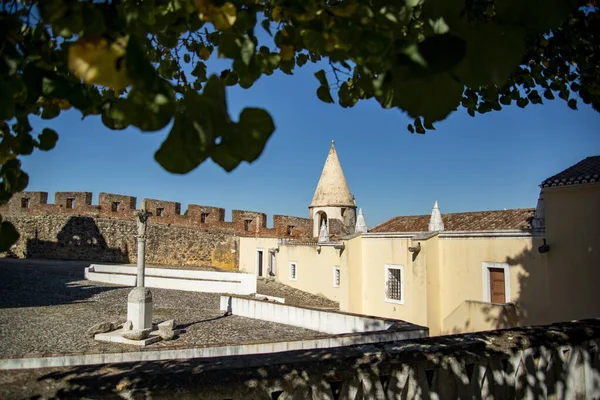
The castle is located on the outskirts of Viana do Alentejo, on a little elevation on the northern flanks of the Serra de Viana. The parish church is situated along the south wall, and the Church of the Misericórdia is positioned along the northwest wall, with the historic cross of Viana do Alentejo located roughly in the centre.
The base is located in the south and points north. The shape of the building is an irregular pentagon with five walls and five cylinderal towers at each corner. The battlements defend the structure’s walls, which are composed of exposed brick with apertures and slots for ventilation. The two churches face their respective walls as a result of their placement.
Within these boundaries was built the Manueline-era parochial church (1521), credited to Diogo de Arruda, an important master craftsman in the Alentejo comarca at the time. Across from this structure is the Church of the Misericórdia, also credited to Arruda at the same period. It housed the municipal offices until the late 17th century.