In Cascais, the light plays tricks.
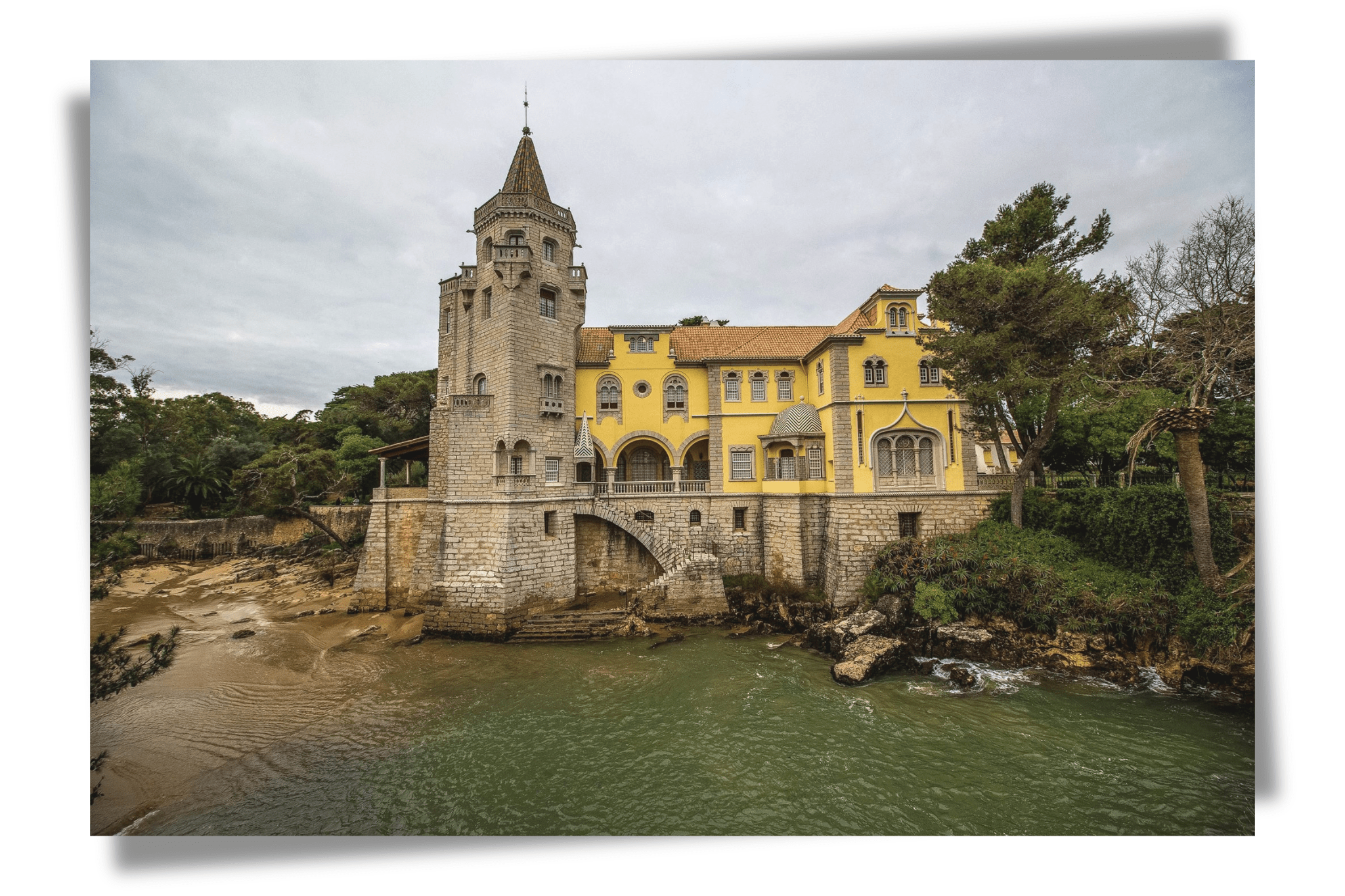
It glides over the bay like silk, catches the edges of tiled facades, and lingers longest where the land meets the sea. And at the mouth of the Marechal Carmona Park, just beyond the marina, there’s a turreted silhouette that looks more like a dream than a building; part castle, part manor, part storybook.
This is the Palácio dos Condes de Castro Guimarães, a place where Portugal’s aristocratic past, architectural fantasy, and maritime soul converge. For many travelers, it’s a photo stop. For those who linger, it’s a slow revelation—a glimpse into how art, ambition, and nostalgia once shaped the Portuguese coast.
A Castle by the Sea
At first glance, the palace feels out of time. Its turrets rise like sentinels above the shoreline, framed by cypress trees and the murmur of the Atlantic. There are hints of Gothic romance in its arches, Manueline flourishes in its windows, and Moorish details in its mosaics. It’s a fusion of styles that shouldn’t work, yet it does, perfectly.
Built between 1897 and 1900 for Jorge O’Neill, a Portuguese nobleman of Irish descent, the residence was never meant to be subtle. O’Neill, whose family had deep ties to Lisbon’s high society, commissioned it as a summer home that would evoke both grandeur and imagination. He called on the architect Francisco Vilaça to design something spectacular, and Vilaça delivered a fantasy in stone.
When you stand before its fairytale tower overlooking the shimmering bay of Cascais, you can see why O’Neill chose this site. The palace doesn’t just face the sea; it listens to it. Every gust of wind, every salt-soaked breath off the Atlantic seems to have shaped its personality.

Layers of History
In 1910, the estate changed hands. The new owner, Count Manuel de Castro Guimarães, was a man of culture, collector, musician, and philanthropist. Under his care, the house became a reflection of refinement and curiosity. When he died in 1927, he left the palace and its collections to the town of Cascais, ensuring it would become a museum for all.
The Museu Condes de Castro Guimarães opened its doors in 1931, transforming the private residence into a public space of art and memory. Inside, every room feels like a page from Portugal’s storybook. The furniture remains where it always stood, the chandeliers still throw their warm light across gilded frames, and the hush of history lingers like the scent of old wood and salt air.
But the true soul of the palace lies in its library, a circular room beneath a carved wooden dome, filled with rare volumes, manuscripts, and the quiet hum of time. Among its treasures is the 16th-century illuminated manuscript Crónica de El-Rei D. Afonso Henriques by Duarte Galvão, an early chronicle of Portugal’s first king. Its presence here feels symbolic: a nation’s birth story resting within walls that overlook its restless sea.
A Dialogue Between Eras
What makes the Palácio dos Condes de Castro Guimarães remarkable isn’t just its preservation but its personality. Step inside, and you sense the eccentric taste of an era when art and architecture were personal expressions, not formulas.
In one room, ornate azulejos—Portugal’s signature blue tiles—dance across the walls. In another, the ceiling beams are hand-painted in floral motifs, a private rebellion against minimalism centuries before it became fashionable. There’s a Moorish-inspired cloister with slender arches that frame the gardens, and a grand staircase that curves upward as if rising to meet a dream.
And then there’s the view. From nearly every window, the ocean glows like a painting. Some visitors linger by the glass longer than they do before the artwork, because what hangs beyond feels just as important.
The house doesn’t merely contain art. It performs it.
Cascais: The Setting That Shaped It
To understand the palace, you need to understand Cascais.
Once a humble fishing village, it became a royal retreat in the late 19th century when King Luís I chose it as his summer residence. The Portuguese aristocracy followed, building their own lavish villas along the coast. This wave of prosperity transformed Cascais into a seaside enclave of elegance and leisure, an Atlantic version of the Riviera.
Today, the town retains that duality: part old-world charm, part cosmopolitan energy. The palace, nestled beside the Parque Marechal Carmona, sits at the intersection of both. Behind it, manicured gardens stretch toward shaded paths and peacocks. Ahead, the sea opens into blue infinity.
Cascais is known for its light—soft, golden, and ever-changing. Painters came here to chase it. Writers came to describe it. And at the Palácio dos Condes de Castro Guimarães, the light becomes architecture itself. It spills through stained glass and dances across the tilework, turning the interior into a moving fresco.

Inside the Museum
Visitors today can wander through the palace’s nineteen rooms, each a vignette of aristocratic life. There’s the music room, where a grand piano still gleams beneath an arched ceiling; the dining hall, with its carved chairs and embroidered linens; and the chapel, intimate and quiet, its altar gilded with devotion.
The museum’s collection ranges from Portuguese and Indo-Portuguese furniture to silverware, jewelry, paintings, and ceramics. Each object feels less like an exhibit and more like a trace of the lives once lived here.
Perhaps the most poignant detail is how little has changed. The museum curators resisted modern intrusions. There are no digital displays or QR codes here. The storytelling happens through atmosphere—the creak of a stair, the hush of a velvet curtain, the echo of footsteps in the hall.
It’s one of those rare places where time feels suspended, not frozen but gently held.

The Gardens: Silence and Shade
Step outside, and you enter one of Cascais’s most beautiful green spaces. The Jardim Marechal Carmona, which merges seamlessly with the palace grounds, is a sanctuary of ponds, cypress avenues, and peacocks that strut with royal indifference.
The gardens were designed for reflection. You can walk along shaded paths where light filters through the canopy, or sit by the pond where ducks drift lazily. There’s a stillness here that contrasts the glamour of the town center.
From certain angles, the palace rises behind the trees like a memory, its pale yellow façade softened by distance. And if you listen closely, you might catch the faint sound of the sea, reminding you that Cascais is never far from the ocean’s pulse.
A Living Legacy
Few places capture Portugal’s layered identity like this palace does. It’s not just a monument to wealth or beauty; it’s a reflection of a nation constantly reinventing itself—seafaring, aristocratic, artistic, democratic, modern.
Visiting today feels intimate, almost private. Unlike Lisbon’s grand museums or Sintra’s palatial overload, this one feels personal. You’re walking through someone’s home, but also through a country’s memory.
And that’s what makes it endure. The Palácio dos Condes de Castro Guimarães doesn’t just tell a story. It keeps one.
If You Go
Location: Avenida Rei Humberto II de Itália 1, Cascais
Hours: Tuesday to Sunday, 10:00 am to 5:00 pm (closed Mondays)
Tickets: Entry is modestly priced, with discounts for students and seniors.
Best time to visit: Late afternoon, when the golden light catches the tower and the tide glows silver.
Tip: Pair your visit with a stroll through Marechal Carmona Park or a stop at the nearby Santa Marta Lighthouse Museum.
The Takeaway
There’s a reason travelers return to Cascais again and again. It’s not just the beaches or the restaurants or the proximity to Lisbon. It’s the atmosphere—the sense that beauty and history coexist effortlessly here.
The Palácio dos Condes de Castro Guimarães is its most articulate expression of that feeling. A building born of imagination, rescued by generosity, and preserved for wonder.
Stand in its library and look out to the sea, and you’ll understand something essential about Portugal. The past never really disappears. It lingers in the light, in the sound of the waves, in the quiet pride of a house that still listens to the Atlantic.