With thousands of years of history and one of Europe’s richest patrimonies, Lisbon is a city full of unique and fascinating tidbits of information, so here are a few things you should know before visiting the Portuguese capital.

For example, did you know that beneath the streets of Lisbon’s main commercial district is a subterranean underworld of Roman passageways, bridges, apartments, and galleries? The entrance to this intriguing subterranean quarter is marked by a metal block at the top of Rua da Conceiço, which is only exposed to the public a few days per year due to the slightly perilous conditions down below.
These Roman galleries from the 1st century AD were discovered by accident during the post-1755 Great Earthquake reconstruction. Most of the structure was blocked by the new sewage system built in the 18th century, except this small area you can visit today. Opening the galleries requires draining them before and during visiting days and rerouting all traffic.
The Serra da Arrábida, a large limestone range visible from Lisbon 40 kilometres to the south, is home to the world’s oldest living specimens of Mediterranean vegetation. The Arrábida Natural Park (now designated as a protected area) is notable for its distinctive soil and microclimate, both of which are uncommon in this part of Europe. More than 1,000 plant species have been identified there.


Vasco da Gama, the pioneering Portuguese navigator, prayed in an old mariners chapel in Belém, west Lisbon, all night on July 7, 1497, for the safe return of his captains and crew from their upcoming expedition to India. The mission was a success, as they discovered a fresh sea route to the east. When he returned two years later, the church was demolished and replaced by the majestic Jerónimos Monastery, where his corpse is currently interred.
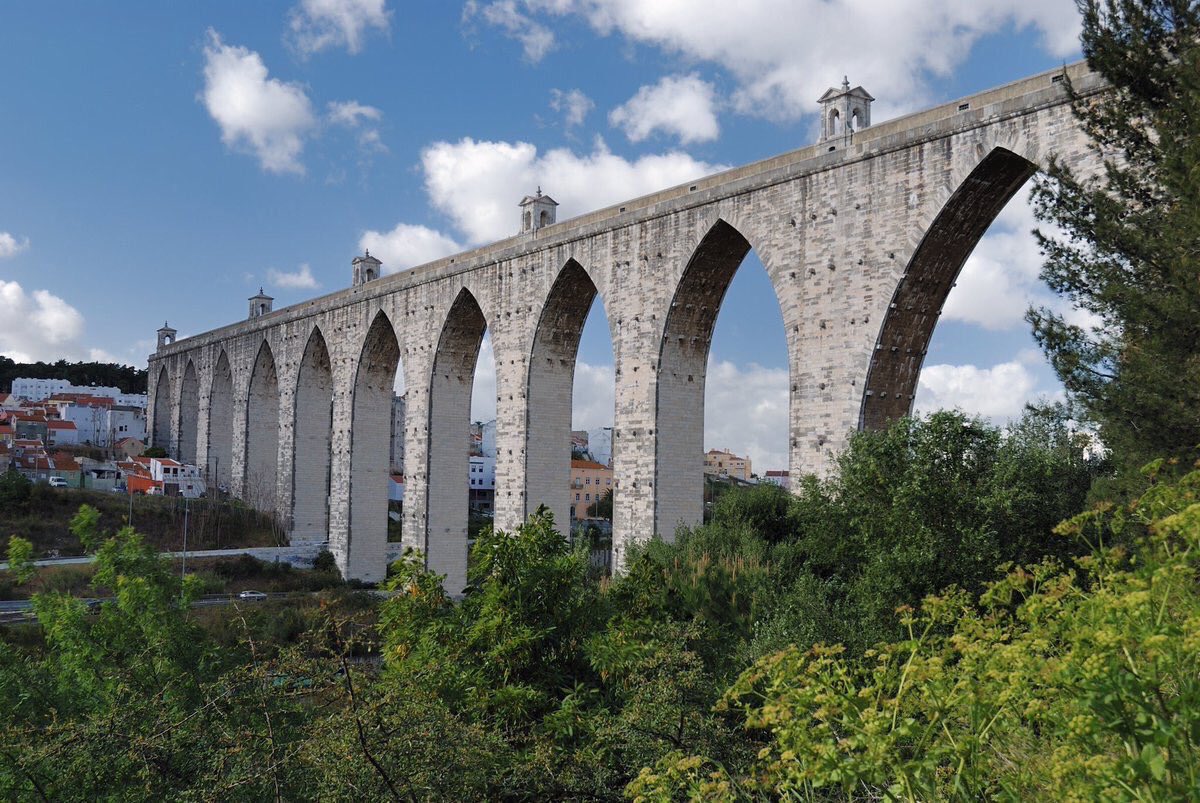
The Aguas Librish Aqueduct (literally, “free waters aqueduct”) is regarded as one of the most remarkable constructions in Lisbon. This magnificent technical marvel, which crosses the Alcantara Valley in the northern area of Lisbon, is part of the Lisbon water delivery system.
The aqueduct is made up of 35 arches, 21 of which are semicircular and 14 of which are lancet, with the highest being 65 meters (making it the tallest ancient building in the world) and the shortest being 33.7 meters. Because of its design, the aqueduct was not damaged by the Lisbon earthquake of 1755. The aqueduct’s length is 941 meters. Essentially, it runs underneath and occasionally emerges on the surface in the form of enormous arcades. The aqueduct was built in the 18th century and spans 19 kilometres (11 miles) from Caneças to the Casa de gua reservoir in Lisbon’s Amoreiras area.
Apart from its naval heritage, Lisbon has also been the site of two aviation world records. In 1922, two Portuguese pilots, Gago Coutinho and Sacadura Cabral flew from Lisbon to Rio de Janeiro in a seaplane called Santa Cruz, completing the first flight across the South Atlantic. Three years earlier, on May 27, 1919, the first North Atlantic flight landed in Lisbon.

The 25 April Bridge, renamed following the 1974 revolution, is one of the world’s longest suspension bridges. The bridge, which stretches 1,013 meters (3,323 feet), opened on August 6, 1966, at a cost of US$45 million. Aside from that, one of its foundations is the deepest of any bridge in the world, with a depth of 79 meters (260 feet) beneath the Tagus river bed.
Another interesting fact about Lisbon is that the main river basin of the Tagus estuary runs 9 miles (14 km) across the city, and at the height of the Portuguese Empire in the mid-16th century, well over 1,000 river vessels were recorded passing between the city’s many ports. The Tagus River begins in the mountains to the northeast of Spain and flows 525 miles (840 kilometres) to Lisbon.