What is the backstory of the Lágrimas Estate?
The Lágrimas Estate is a beautiful property with 20 hectares of fertile land on the left side of the Mondego River. The natural geology of the slope is primarily limestone, making this location a rare and abundant supply of fresh water that rises at the hill’s lower level and runs through three separate channels.
The hill provides shelter from the wind, and the area’s rich soil and plentiful water make it an ideal environment for a wide variety of plant life, including subtropical species like ficus macrophylla, podocarpus, and cinamomun camphora, as well as more temperate species like sequoia sempervirens, cedrus libani, cedrus atlantica, cupressus lusitanica, araucaria bidwilli, camelli An extensive laurel grove has developed, and the bottom layers of plants have spread out unchecked to form a thick maquis typical of the Mediterranean.
A higher ground was used in construction of the home so that it would be safe from flooding. According to the ancient maps, water was considered a “frequent companion” in this community, and the fertile deposits left by the river were appreciated on the islands located on the higher ground near the structures.
Wheat, grapes, and olives, the three classic crops of the Mediterranean, were gathered here; subsequently, orange groves provided plenty of fruit.
The water that emerges from the ground and the rocks at the base of the hill or floods the land every year has always been the most significant aspect of this environment. The area was encircled by the Mondego River, and the resulting lake was peaceful and reflective. At that time, it seemed like a waterscape, with the house situated on an island and the trees reflected in the lake. Because of these inherent characteristics, this location stands out from the others.
When did the Gardens of Lágrimas Estate first come into being, and what events led up to its current state?
Over the ages, the Gardens of Lágrimas Estate have served as the site of countless celebrations and social gatherings. In 1326, Queen Saint Isabel had a new canal built to provide water from springs on the land to her adjacent convent, Saint Claire.
 The other spring on the property, which was given the name “Fountain of Tears” (Fonte das Lágrimas) by the poet Camões, is said to have been formed by Inês’s tears while she was being killed. After 650 years, Inês’ blood is still visible in the canal’s stones. … “Camões writes in “The Lusíadas,” “Tears are the water, and the name is love.” “
Paths and fences were marked out in the woods and a wall was constructed around the land around the year 1650. Water from the Fonte das Lágrimas fountain is collected in a big pool. Water was channelled from the pool to the olive mill’s grinding wheel, resulting in plentiful, high-quality olive oil.
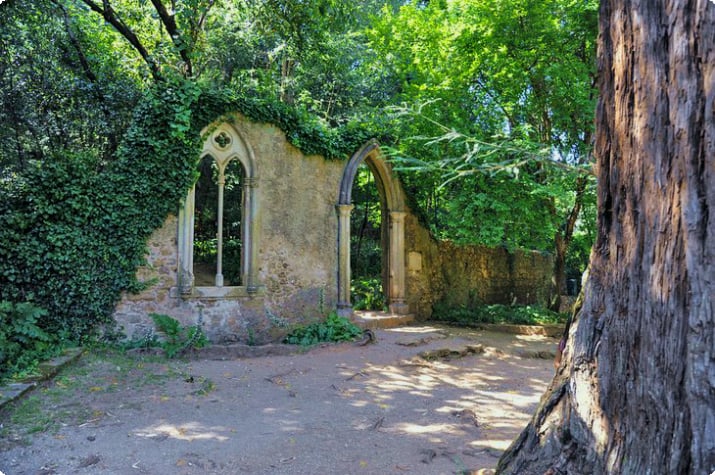
The current proprietors of Lágrimas Estate may trace their lineage back to António Maria Osório Cabral de Castro, the Duke of Wellington’s aide-de-camp and the owner of the Quinta where the duke stayed in 1813. The ceremony was marked by the planting of two Wellingtonian trees (Sequoia gigantea) and a stone bearing an inscription of the well-known lyric from “The Lusíadas” about Pedro and Inês’s love tale. Around 1850, António’s son Miguel had a picturesque garden designed and developed, complete with winding lakes and exotic and uncommon plants that, even now, survive in the Quinta’s environment. D. Duarte de Alarcão Velasquez Sarmento Osório, his nephew and the present owners’ great-grandfather, added an archway and a neo-gothic window to the mine that Queen Saint Isabel had constructed. Both the entrance and window provide access to the hidden forest realm beyond. Several monarchs, including the Brazilian Emperor and the Portuguese King Miguel, paid visits to their respective countries throughout the nineteenth century.
In 1995, the Hotel Quinta das Lágrimas opened its doors to guests. In 2004, the hotel commissioned architect and Académie des Beaux-Arts in Paris Prize Winner Gonçalo Byrne to create a new wing that would house guest rooms, conference spaces, and a spa. Donated to the Inês de Castro Foundation in 2006, the gardens’ makeover was spearheaded by landscape architect Cristina Castel-Branco. The Medieval garden’s layout was revamped, and its wooden walls and canals of Love and Tears were repaired. The Colina de Cames amphitheatre was erected, and a flora curtain, sequoia forest, and Japanese garden were planted inside the hotel grounds (it won the Portuguese Landscape Architecture Award in 2008). There has been no tampering or alteration to any of these landmarks; the Fonte dos Amores and the Colina de Cames are both located in their original positions.
Chronology
1326 fountains and canals
1601 large pool to store water and canals to feed the mill for olive oil production
1858 creation of the Romantic Garden
1995 transformation of the palace into a hotel
2004 restoration of the garden
Type of Historical Garden: Romantic 19th century garden including a medieval fountain
Address:Hotel Quinta das Lágrimas
Rua António Augusto Gonçalves
Santa Clara – Apartado 5053
3041 – 901 Coimbra, Portugal
Web: quintadaslagrimas.pt
Region: Centre
Municipality : Coimbra
Town : Coimbra
Place : Santa Clara
Lat.: 40°11’51.45″N
Long.: 8°25’57.69″W
Access from the provincial capital :From Lisbon: High way 2 hours, train 2 hours
Access from the nearest place to the site :Easy Bus and pedestrian
.