The Natural Environment of the Gardens
The cultural landscape of Sintra lies in central Portugal, at the westernmost tip of the Iberian Peninsula, a few kilometers from the Atlantic Ocean. This cultural landscape is an amazing mix of natural and cultural sites in an unmistakable setting. From a distance, it essentially gives the impression of a natural landscape, contrasting with its surroundings. It’s a small chain of forested granite mountains towering over rolling countryside. Seen up close, the Serra reveals a surprisingly rich cultural history that spans centuries of Portuguese history.
This cultural landscape is an exceptional and unique complex of parks, gardens, palaces, country houses, monasteries and palaces that create architecture in harmony with exotic and lush vegetation, creating an exotic and lush beauty. creating a microscopic landscape. This fusion of exotic styles transforms the landscape into a lush world, taking visitors from one discovery to the next, offering surprises at every turn. Its uniqueness and vegetation abundance as well as its charming surroundings make it unique in the landscape.
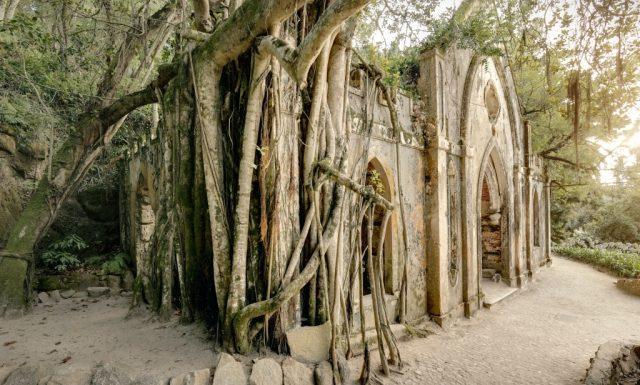
This syncretism between nature and ancient monuments, villas, monasteries and chalets has influenced the development of landscape architecture throughout Europe.
Monserrate Palace was designed by noted British architect James Knowles Jr. for Sir Francis Cook. Again, an example of mid-19th-century eclecticism adapted to the remains of an earlier building destroyed by the 1755 earthquake. It combines key elements of Gothic Revival and Indian architecture. Monserrate is known for its gardens, mostly the work of Thomas Gargill. A careful analysis of the country’s microclimate allowed us to plant more than 3000 of his exotic species, collected from all over the world. Monserrate Park covers his 50 hectares on the northern slopes of the Serra. William Beckford’s late 18th-century remodelling of the existing palace included the creation of landscaped gardens.
The historical background of the gardens Four kilometres from the historic centre of Sintra and a testament to the eclectic taste of the 19th century, Monserrate’s peerless palace and park is home to an array of exotic plants in the interiors of its buildings. The motif spreads harmoniously in the outdoor garden.
The Monserrate estate was rented to Gerard de Visme (1789), a wealthy English merchant, who built a neo-Gothic house on it. William Beckford then unleashed the Monserrate from 1793 to 1794, but when Lord Byron visited the estate in 1809, the house was already in ruins. The stately appearance of the mansion was a source of inspiration for the poet. The poet sang about the beauty of Monserrate in his poem “Childe Harold’s Pilgrimage”, after which foreign travellers were obliged to visit the mansion.
One of his most famous visitors was Francis Cook. He was one of the very wealthy English industrialists, later made Viscount Montserrate by King Louis, who was granted the estate in 1856.
 Over the years, the surrounding gardens have attracted plant species from all over the world. Arranged by geographic area (perhaps most notably Mexico), the gardens showcase the diverse origins of plants that compose different landscape effects along paths through ruins, hidden nooks and crannies, and past lakes and waterfalls. It reflects. Monserrate Park grew to be what it is today thanks to the intervention of painter William His Stockdale and master gardener Francis Bart, but above all, thanks to the romantic spirit of Francis Cook. As you stroll the winding paths of the various gardens and interact with the native species of the region (strawberry trees, holly bushes, majestic cork oaks, etc.), Arocaria, palm trees, and tree ferns suddenly emerge. You can find amazingly contrasting landscapes that look ancient. From agave and yucca that reproduce in parts of Australia, New Zealand, and Mexico. As you stroll through the botanical gardens of five continents, you’ll also see camellias, azaleas, rhododendrons, and bamboo, which will bring back memories of Japanese gardens. In 1949, the estate and palace were purchased by the Portuguese government.
The park and palace of Monserrate were classified as properties of public interest in 1993, included in the Cultural Landscape of Sintra, and declared a World Heritage Site by UNESCO in 1995.
Sintra embarked on an extensive restoration and restoration programme, which made it possible to open the palace to the public while restoring the park’s historic gardens to their former glory. In 2013, Monserrate Park won the European Garden Award in the category “Best Development of a Historic Park or Garden.”
Portugal
UNESCO World Heritage Designation : Yes, 1995 / 723
Type of Historical Garden: Botanic Garden | Romantic Park | English Landscape Garden
Address:Parque de Monserrate, 2710-405 Sintra, Portugal
Region: Lisbon Metropolitan Area
Municipality : Sintra
Town : Sintra
Place : Park of Monserrate / Parque de Monserrate
Google Maps Coordinates:8°47’30.9″N 9°25’09.1″W
38.794134 -9.420613
Access from the provincial capital :By car
If driving to Sintra, take the IC19 (from Lisbon), IC30 (from Mafra) or EN9 (turning off the A5 motorway to Cascais).
When you arrive in the town’s historic centre, you’ll see a vertical sign showing the way to Monserrate (3.5 km).
Public transportation
Lisbon > Sintra
By train (CP) – Take the Sintra Line
Departure stations:
– Estação do Oriente
– Estação do Rossio
– Estação de Entrecampos
Sintra (historic centre) > Park and Palace of Monserrate
– By bus (Scotturb)
– From Sintra Train Station
From Sintra, take Scotturb bus No. 435, which runs from the railway station to the Palace and Park of Monserrate.
Access from the nearest place to the site :Sintra (historic Sintra) – Take N375 (by car or public transportation)