The old royal summer house of Queluz, west of Lisbon, is a popular stopover for travellers while on the way to the mediaeval town of Sintra. It is elegant and modest.
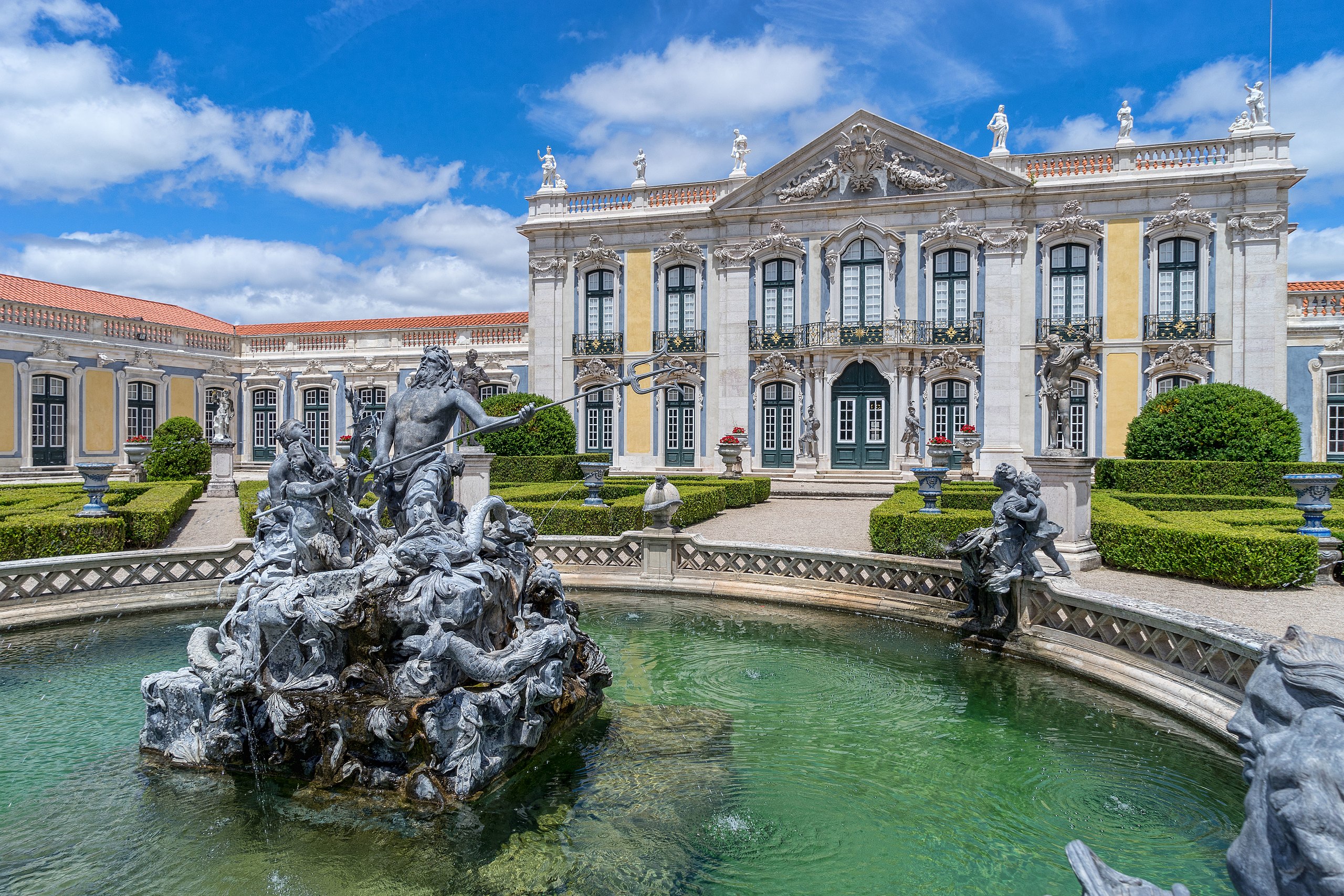
It is considered one of Europe’s most brilliant and shining examples of rococo architecture, and the building (along with its rambling 18th-century gardens) still retains a strong sense of its long royal history. It is located in the bustling suburb of Queluz, just 14km (8 miles) west of the Portuguese capital.
It was commissioned by Prince Pedro (later to be proclaimed king) and erected between 1747 and 1794 by the French architect Jean-Baptiste Robillon and the Portuguese Mateus Vicente de Oliveira from a 17th-century hunting lodge. Once completed, it became the Bragança dynasty’s primary summer house and the favourite palace of Queen Maria I, who lived there for the whole of her turbulent 39-year reign.
The prince’s marriage in 1760 to Princess Maria, his niece and successor to the throne, earned him the title of King Pedro III of Portugal because the couple had already produced sons when she ascended to the throne.
The inside of the palace is divided into a variety of exquisite rooms and hallways, each with its own fine array of finely painted walls, golden mirrors, and opulent ceilings. The elaborate Throne Room, with its brilliant Venetian chandeliers, the Ambassador’s Hall (with its exquisite troupe l’ceil ceiling), the oval Hall of Mirrors, and the royal bedroom (Don Quixote Chamber), where King Pedro IV was born and died, are the most sumptuous of them all.
The palace, which is made up of a central block and two wings, is filled with Portuguese tapestries and furnishings, Florentine marbles, Delft tiles (some of which are very old), Chinese screens, rare Austrian porcelain, Rabat carpets, Brazilian jacaranda wood pieces, and many other exquisite antiques.
The palace’s perfectly-manicured gardens, constructed by Robillon in 1763 and adorned with formal balustrades, majestic fountains, and magnificent statues, are the pride of the palace and a must-see sight for travellers travelling the Greater Lisbon region.
A rich scattering of exotic bushes have been barbered into a variety of inventive shapes among its neatly sculpted box hedges, shaded ponds, hidden grottoes, towering cypress trees, and leafy walkways, and in summer the entire area is aglow with ancient magnolias, scarlet geraniums, mauve petunias, climbing roses, and bougainvillaea cascades.
The royal household and its numerous aristocratic visitors would enter the garden by the majestic Lion Staircase and enjoy summer dinners, serenades, concerts, and firework displays before boating down the azulejo-lined Dutch canal in the centre of the palace grounds.
Hundreds of live animals, including lions, tigers, and monkeys, were housed in a menagerie (now modified for falconry) around Queluz Palace’s famed Shells Cascade in the early nineteenth century. The Portuguese School of Equestrian Art (Escola Portuguesa de Arte Equestre), which is housed in the palace gardens, perpetuates the animal legacy with occasional demonstrations of dressage and horsemanship.
The royal kitchens are now an elite restaurant named Cozinha Velha that specialises in traditional Portuguese cuisine and has a massive fireplace, giant spits, a long marble worktable, and an astonishing array of copper pans (reservations are strongly suggested).