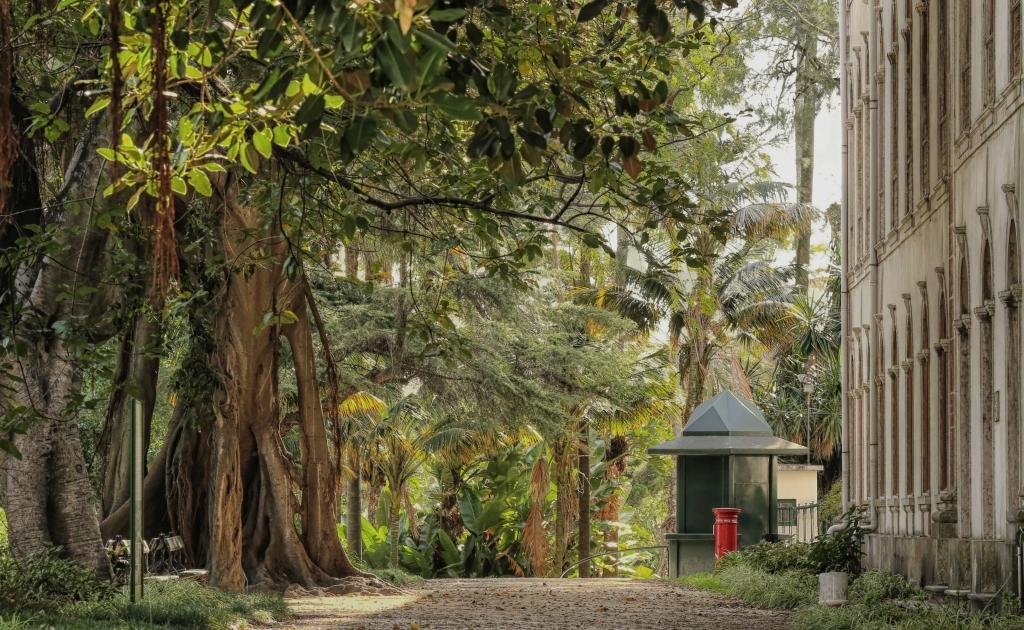
 The Lisbon Botanical Garden, located in the city’s central area and on one of the city’s seven hills–São Roque–is framed by several palaces and a diverse set of classified properties. It takes up five hectares of the block’s “interior,” between the Avenue of Liberty (“Avendia da Liberdade”) and the Jardim do Principe Real. The Botanical Garden of Lisbon, founded in 1878, is now part of the Museu Nacional de História Natural e da Ciência. This Garden, with its richness of botanical species (approximately 1300) distributed by a variety of corners and slopes, is a reference in urban biodiversity. It can be considered an oasis of silence and a pure atmosphere in the heart of Lisbon.

The Botanical Garden of Lisbon is a scientific garden founded in the mid-nineteenth century to supplement modern teaching and botany research at the Polytechnic School. The chosen location on Mount Olivete already had a more than a two-century tradition in the study of Botany, beginning with the Jesuit College of Cotovia, which was established here between 1609 and 1759. In 1843, a draft regulation was created for the installation of the garden at this location. The planting, however, did not begin until 1873, thanks to the initiative of Count of Ficalho (1837-1903) and Andrade Corvo (1824-1890), teachers at the Polytechnic School. The enormous diversity of plants was first collected by the German Edmund Goeze (1838 – 1929) and the French Jules Daveau (1852 – 1929) from all over the world in which there were territories under Portuguese sovereignty. Edmund Goeze, the first chief gardener, outlined the “Class,” and Jules Daveau was in charge of the “Arboretum.”
The garden design was well-suited to the site and the mild climate of Lisbon. The young plants quickly thrived, occupying all the space and soon knew how, over time, the city would gain the most, despite the design of sidewalks, flowerbeds, and terraces interconnected by lakes and waterfalls. A pleasant green space with the greatest scenic and botanical interest. The first seed catalogue was published in 1878.

The most significant intervention in the garden occurred in the late 1930s and early 1940s. The primitive systematic ordering of the Garden’s upper terrace was replaced by the grouping of species in ecological groups under Director Ruy Telles Palhinha (1871 – 1957).
The Garden, in collaboration with the Museum’s other departments, provides active environmental education programs for various age levels, as well as guided thematic visits.
The garden is managed by the National Museum of Natural History and Science of the University of Lisbon. The Lisbon Botanical Garden was designated a national monument by the Ministry of Culture in 2010.
Address: Rua da Escola Politécnica 56/58,
1250-102 Lisboa
Portugal
Phone:
+351 213 921 808
Web: museus.ulisboa.pt/pt-pt/jardim-botanico-lisboa
E-mail: geral@museus.ulisboa.pt