The Living Canvas of Válega
“Some places don’t just tell a story — they sing it, in tiles and light.”
Where It Stands
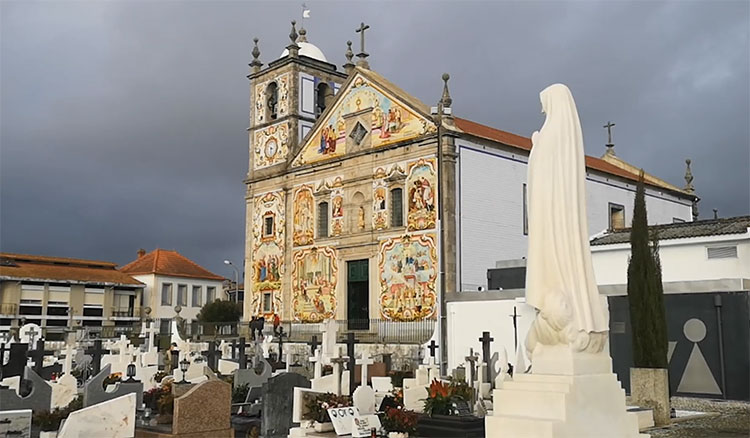
In the quiet village of Válega, a few kilometres from Ovar in northern Portugal, there’s a church that looks as if it was painted by the sun itself. The Igreja Matriz de Santa Maria de Válega, better known simply as Válega Church, rises from the landscape like a living mosaic — a vision of color and devotion that catches your breath before you even step inside.
This part of Portugal, between Porto and Aveiro, is a gentle stretch of countryside dotted with tiled homes, olive groves, and the occasional stork perched on a telephone pole. Most travelers speed through on their way to the coast, unaware that one of the country’s most remarkable works of art sits quietly here, glowing with every shade of faith and craft.
The Story Behind the Colors
Válega’s parish has deep roots. The earliest records of a church here date back to the 12th century, when the land was under the protection of the monastery of São Pedro de Ferreira. Over time, the small rural parish changed hands between noble families and the diocese of Porto, its wooden chapel slowly evolving into a more permanent stone structure.
But the building we see today — that extraordinary facade of glazed tile and shimmering glass — was largely shaped in the 18th century and transformed again in the mid-20th century. The structure itself is Baroque in origin, but its radiant tiles were added in the 1950s and 60s, designed and produced by the famed Aleluia tile factory of Aveiro.
This was a time when Portugal was rediscovering its artistic confidence. Craftsmen were blending centuries-old azulejo techniques with modern colors and compositions. Válega Church became their masterpiece — a symbol of how faith and creativity could merge into one breathtaking statement.
The First Glimpse
Approaching from the narrow village road, the church seems to appear out of nowhere — one moment you’re passing stone houses and gardens, and the next, your entire view fills with color.
The facade is a spectacle: scenes from the Bible play out across thousands of ceramic tiles, framed by granite stonework and crowned by a bell tower on the left. Every tile catches the light differently — soft pinks, cobalt blues, golden yellows, sage greens — a palette that feels more Mediterranean than northern Portuguese.
If you visit at sunset, the western light ignites the tiles, turning them to molten gold. The angels and saints seem almost alive, the details of their faces and robes glowing in a kind of divine warmth. The courtyard in front is small and plain, but that contrast only heightens the effect — as though the earth wanted to step aside and let the art speak.
“The façade feels like a sunrise frozen in tile.”

Inside the Sanctuary
Step through the wooden doors and the air shifts — cool, resin-scented, hushed. The interior continues the dialogue between color and calm. The walls are lined with blue and white tiles, each panel telling scenes from the life of the Virgin Mary. These are quieter, more restrained than the explosion of color outside, but equally intricate.
Above, the ceiling glows with polished exotic wood, donated by a local benefactor in the 20th century. The craftsmanship is exquisite — smooth, warm, with carved beams that ripple with light. Sun filters through stained-glass windows imported from Madrid, casting soft washes of red and violet onto the stone floor.
At the front stands the 18th-century main altar, richly gilded and carved in the late Baroque style, framing a statue of the Virgin Mary. To one side, an early 16th-century baptismal font carved from pale Ançã stone serves as one of the church’s oldest relics — proof that while the colors may be new, the faith here has endured through centuries.
The Art of Azulejos
No photograph fully captures what it feels like to stand before those tiles. Each one is hand-painted, a single piece of a massive visual story. Together, they depict moments from scripture — the Annunciation, the Nativity, the Ascension — but they also speak of the artisans themselves: their patience, their pride, their understanding of how light interacts with glaze.
Azulejos are part of Portugal’s identity, but Válega takes them to another level. Unlike the typical blue-and-white motifs found on most churches, here the tiles burst into full polychrome. This was daring in its day — a statement that faith could evolve without losing its roots.
The result is not just decoration; it’s storytelling through color. The tiles invite you to step closer, to trace the brushstrokes, to see where human hands met divine inspiration.
“Every color here seems chosen to remind you that joy, too, can be sacred.”
The People Behind It
The church’s restoration and decoration were largely financed by Commander António Augusto da Silva, a Portuguese businessman and philanthropist who wanted to gift his hometown something enduring. Working with Aleluia’s master artisans, he oversaw a project that would turn Válega’s humble church into a national treasure.
The tiles, produced and installed between 1958 and 1960, were designed not only to beautify the church but to embody the spirit of devotion and community. Local families contributed materials, labor, and even the flowers that still decorate the altar today.
Válega Church, in that sense, is more than architecture — it’s a love letter from a small town to its faith and craft.
How to Experience It
Best Time to Visit
Late afternoon is magical. The western sun hits the tiles directly, bringing out their full vibrancy. On cloudy days, the colors soften into a pastel dream, equally beautiful in a more introspective way.
Inside, mornings are best for photography — the natural light filtering through the stained glass is at its most balanced.

How to Get There
Válega lies roughly halfway between Porto and Aveiro.
-
By car: Take the A1 or A29 motorways and exit toward Ovar, then follow local signs for Válega. The drive from Porto takes about 40 minutes.
-
By train: Regional trains from Porto’s Campanhã Station stop in Ovar; from there, it’s a short taxi or local bus ride to Válega.
Parking is easy and free beside the church.
Entry & Visiting Tips
The church is generally open in the afternoons and during Sunday mass, though hours can vary. There’s no entry fee. Dress respectfully and take your time — this is a place meant for slow appreciation, not quick photos.
If you’re a photographer, bring a tripod and visit twice: once in bright daylight, once near sunset. You’ll come away with two entirely different moods.
Beyond the Church
Once you’ve soaked up Válega’s magic, don’t rush off. The surrounding area offers more layers of quiet beauty.
Ovar: Just ten minutes away, this small coastal town is known for its Art Nouveau facades and the local delicacy, Pão-de-Ló de Ovar — a soft, rich sponge cake worth the detour.
Aveiro Lagoon: About 20 minutes south, the lagoon offers peaceful boardwalks, salt flats, and birdwatching.
Furadouro Beach: If you’re craving the sea, drive west to the Atlantic and watch the fishermen pull in their nets at sunset.
Together, these stops make a perfect day trip that combines art, culture, and nature — a triad that defines the spirit of central Portugal.
A Place of Quiet Wonder
Válega Church isn’t famous in the guidebooks, and that’s part of its charm. You can stand there alone in the courtyard, listening to the distant clatter of storks on the roof, and feel as if time has paused just for you.
The tiles, in their brilliance, don’t shout. They shimmer. The colors tell stories not only of heaven and saints but of human hands creating something that lasts.
“It’s not the size of the church that matters, but the way it holds light.”
In a world that moves too fast, Válega invites you to slow down — to see beauty the way it was meant to be seen: patiently, attentively, with gratitude.
Travel Notes
Region: Aveiro District, Northern Portugal
Nearest Town: Ovar (6 km)
Coordinates: Approx. 40.86° N, 8.58° W
Built: Original 12th century; current structure 18th century; tilework 1950s–60s
Architectural Style: Baroque with Neo-Baroque and 20th-century artistic tile additions
Highlights:
-
Vibrant azulejo facade by Aleluia Factory, Aveiro
-
16th-century baptismal font
-
Stained glass from Madrid
-
Carved wooden ceiling
-
18th-century gilded altar
Photographer’s Tip: Bring a polarising filter to cut glare from the tiles and enhance the colors.
Accessibility: The entrance is level, though the courtyard is cobblestone. The interior is spacious and well lit.
Local Insight: Sunday mornings bring a handful of parishioners and the sound of hymns that spill softly through the open doors. It’s the best time to feel the church alive, not just admired.
When to Go
Spring and autumn are ideal. The light is gentle, the fields around the village turn green or golden, and you can combine the visit with a trip along the Silver Coast. Summer afternoons can be hot, but that only makes the shade inside more inviting.
Winter adds a melancholic charm — mist in the fields, the tiles gleaming even in grey weather, and the sound of rain on the church roof echoing like a whispered prayer.
A Final Reflection
Standing in front of Válega Church, it’s hard not to think about the patience it took to create something like this. Tile by tile, brushstroke by brushstroke, generations of artists and villagers left behind a visible form of belief — not loud, not boastful, but luminous.
Traveling through Portugal often feels like peeling back layers of time. Here in Válega, those layers shimmer side by side — medieval roots, baroque architecture, 20th-century color. It’s a perfect reflection of the country itself: timeless, evolving, deeply human.
When you leave, the colors seem to follow you — in your eyes, on your camera, maybe even in your heart. And that’s when you realise: this isn’t just a church. It’s a living canvas.
Let Us Discover: Finding the extraordinary in the quiet corners of Portugal.