


Monsanto, perched atop a mountaintop and interwoven with the Portuguese landscape, epitomises a geographical marvel. The village is characterized by houses that are cleverly nestled among, atop, and beneath colossal boulders. The remnants of a Templar castle, partially demolished by an explosion in the 19th century, crown this mountaintop, which has held significant strategic importance since prehistoric times.
The architectural fabric of Monsanto has remained largely unchanged for centuries, affirming its status as a living museum within Portugal. This designation prohibits any alterations, allowing the village to maintain its quintessential charm.
The village’s narrow lanes ascend steeply, flanked by cottages with red roofs pressed against verdant boulders, some of which feature doors leading into interiors carved directly from the rock. This integration of natural elements provides a distinctive twist on traditional Portuguese architecture.
A stroll along its cobblestone streets reveals that Monsanto is a condensed representation of Portugal itself. The architecture here reflects the Manueline style, as evidenced by several edifices and a church. While it adheres to the classic Portuguese village aesthetic, the unique ‘boulder chic’ cottages frequently eclipse the appeal of the mediaeval Romanesque or Manueline styles.
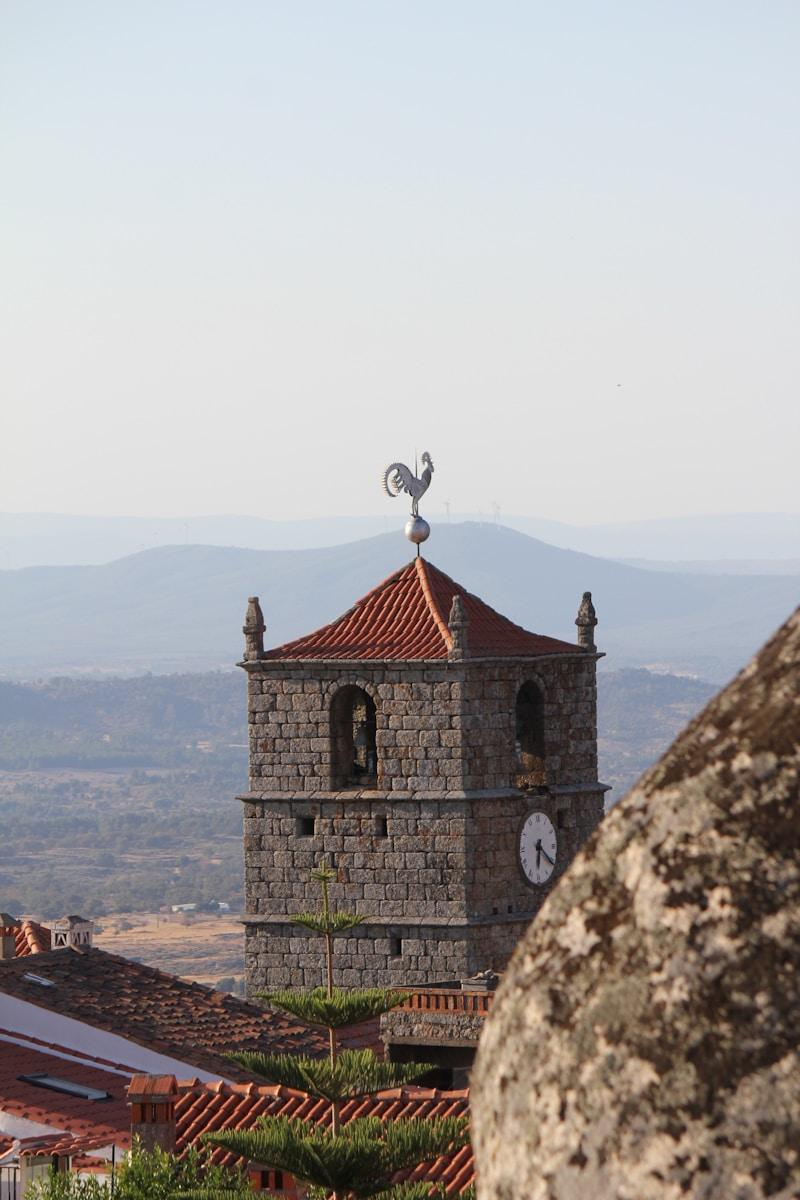
Monsanto exudes a timeless aura, encapsulating a panorama that includes Castelo Branco and the Estrela Mountains. For centuries, the village’s Lucan’s Tower has chimed the hours in an unaltered cadence, anchoring the community in a seemingly eternal moment.
The village’s ancient origins, steeped in prehistoric ties to pagan rituals, and its subsequent history under the stewardship of Gualdim Pais, Master of the Knights Templar, who fortified it with an impregnable castle, illustrate its remarkable and enduring legacy.
Monsanto is widely recognized as “Portugal’s most Portuguese hamlet”
Monsanto boasts an extensive and multifaceted historical background, distinguished by its centuries-long strategic importance and unique cultural legacy.
Periods: prehistoric and ancient
Evidence suggests that humans recognized Monsanto’s advantageous position as early as the Palaeolithic period. It is probable that prehistoric civilisations utilised the elevated, craggy vantage point for defensive purposes. During their rule of the Iberian Peninsula, the Romans recognised Monsanto’s strategic value and built a colony at its foot.
The mediaeval era
Throughout the Middle Ages, Monsanto’s historical importance increased. The Reconquista, a sequence of campaigns led by Christian states to reclaim territory from the Moors, regarded the village as a pivotal location due to its formidable position. The Moors initially conquered Monsanto, but Afonso Henriques, the coronation monarch of Portugal, recaptured it in the 12th century. In 1165, King Afonso Henriques gave the village to the Knights Templar, a military order that was very important in the Reconquista. The Templars constructed the fortress, which is still partially standing today, bolstering Monsanto’s position as a military bastion.
An organization called the Order of Knights
Following the fall of the Templars in the early 14th century, the Order of Christ, and then the Order of Santiago, seized possession of Monsanto. These orders were responsible for the preservation of the village’s fortifications and the promotion of its progress. The Templar citadel expanded and underwent numerous modifications throughout this time period.
Preservation and declination
By the turn of the nineteenth century, Monsanto had undergone a substantial decline. An explosion in 1815 caused damage to the castle, leading to the neglect of its walls. However, the twentieth century revived Monsanto as a historical and architectural landmark. In 1938, the declaration of Monsanto as a “most Portuguese village of Portugal” sparked attempts to conserve its cultural history and distinctive architectural elements.
Modern Era
In addition to its historical significance, people today celebrate Monsanto as a living museum of Portuguese mediaeval architecture. Houses nestled into narrow cobblestone roadways and expansive boulders offer a unique glimpse into the past. The settlement appeals to both visitors and historians because of its gorgeous surroundings and the legends contained in its old stones.
Monsanto’s continuing legacy as a fortified hamlet, its importance in Portuguese military history, and its preservation as a cultural heritage monument make it an intriguing topic for history and architectural buffs.
- PLACES OF INTEREST
- Castle of Monsanto
- Chapel of Saint Peter de Vir à Corça o Chapel of Saint Peter de Vira-Corça
- Roman archaeological site of Saint Lawrence
- Old village of Monsanto
- Pillory of Monsanto
- Tower of Lucano
- Chapel of Our Lady of Azenha
- Chapel of Our Lady of the Foot of the Cross
- Chapel of Saint Mary of the Castle
- Chapel of Saint Anthony
- Chapel of Saint Joseph
- Chapel of Saint Michael of the Castle
- Chapel of Saint Sebastian
- Chapel of the Holy Spirit
- Ferreiro Fountain
- Church of Mercy of Monsanto
- Parish Church of Monsanto or Church of the Saint Savior
- Solar of the Marquis of Graciosa Family (Posto de Turismo do Monsanto)
- Solar of Melo Family or Solar of the Counts of Monsanto
- Solar of Pinheiro Family or Solar of the Mono Fountain
- Solar of the Priors of Monsanto
Monsanto is a historic village in central Portugal’s municipality of Idanha-a-Nova, within the district of Castelo Branco. Known for its striking granite boulder houses and ancient fortress, it offers a glimpse into a unique architectural and cultural heritage.
To reach Monsanto, there are several options, depending on your starting point:
From Lisbon:
-
The most straightforward way to get to Monsanto is by car. It’s approximately a 2.5- to 3-hour drive from Lisbon, covering about 270 kilometers. You would take the A1 from Lisbon, switch to the A23 at Torres Novas, and continue towards Castelo Branco before following local roads to Monsanto.
-
Public Transport: Although there is no direct train service to Monsanto, you can take a train or bus to Castelo Branco. From Castelo Branco, you can catch a local bus to Monsanto, though services might be limited, so it’s advisable to check the latest schedules.
From Porto:
-
By Car: Driving from Porto takes around 3 to 3.5 hours, covering a distance of approximately 280 kilometers. The route typically involves taking the A1 south, then the A25 towards Viseu, and switching to the A23 that leads to Castelo Branco and onwards to Monsanto.
-
By Public Transport: Similar to Lisbon, there’s no direct rail or bus connection to Monsanto. You can travel by train or bus to Castelo Branco and then take a local bus to Monsanto. Ensure to verify the timetable, as the frequency of local buses can be sparse.
Local Tips:
- Renting a car may be the most flexible option for exploring Monsanto and the surrounding countryside.
- Accommodation: To fully experience the region, it might be beneficial to stay in Monsanto or nearby towns like Idanha-a-Nova or Castelo Branco.
- Navigation: GPS or a reliable map is recommended, as rural road signage can sometimes be inadequate.
Visiting Monsanto offers a time travel experience with its medieval streets, ancient castle ruins, and distinctive houses integrated into the boulder-strewn landscape. Whether you choose to drive or use public transport, the journey is well worth the experience of reaching this unique village.
![boats docked near seaside promenade]](https://letusdiscover.com/wp-content/uploads/2025/07/prb-sjoubfs-770x635.jpg)