In the heart of Coimbra, where the Mondego River curves through history and the air is filled with student songs and church bells, there stands a monument like no other in Portugal.
The Monastery of the Holy Cross (Mosteiro de Santa Cruz) is not only one of the country’s most important religious sites, but it is also where Portugal’s identity took root. Here, faith, art, and power converged to form the early pulse of a new nation.
It is where Portugal’s first two kings, Afonso Henriques and Sancho I, lie in eternal rest. It’s where monks laid the foundations of education that would give rise to the University of Coimbra, and where centuries of devotion, politics, and beauty intertwine in one unforgettable place.
Let’s step inside and uncover its story.
A Monastery Born from Faith and Nationhood
The Monastery of the Holy Cross was founded in 1131, just before Portugal officially became a kingdom. At that time, Coimbra was the seat of Count Afonso Henriques, not yet a king, but already dreaming of independence from the Kingdom of León.
He granted land and privileges to a group of Augustinian canons, whose leader, Saint Theotonius, became one of the most revered figures in Portuguese religious history. Together, they began the construction of a Romanesque monastery on the site that would soon become sacred ground for the Portuguese crown.
When Afonso Henriques declared himself the first king of Portugal (Dom Afonso I) in 1139, Santa Cruz stood as both a spiritual and political symbol of the new realm. It was, in every sense, Portugal’s first royal pantheon, the place where divine blessing met royal ambition.
The Pulse of Early Coimbra
To understand Santa Cruz, you have to picture 12th-century Coimbra: a city of steep lanes and defensive walls perched above the river, freshly wrested from Moorish control. The monastery became a center of learning, prayer, and governance, serving as a beacon of order in the uncertain years of nation-building.
The Augustinian monks of Santa Cruz weren’t just men of prayer; they were thinkers, writers, and administrators. They helped shape early Portuguese law and theology, copying manuscripts in the scriptorium and advising the monarchy on governance.
In many ways, Coimbra’s golden intellectual age began here. The monastery’s influence spread so widely that when the University of Coimbra was founded in 1290, it drew heavily on the educational and spiritual legacy of Santa Cruz.
A Renaissance Rebirth
By the early 1500s, centuries of wear and political turbulence had taken their toll on the monastery. Then came the reign of King Manuel I (1495–1521), a monarch determined to express Portugal’s growing power and wealth through architecture.
Under his patronage, Santa Cruz transformed. The monastery was almost entirely rebuilt in the Manueline style, Portugal’s flamboyant interpretation of late Gothic, infused with maritime and natural motifs symbolizing the country’s seafaring triumphs.
Architects Diogo de Boitaca, Marcos Pires, and Diogo de Castilho, along with sculptor Nicolau Chanterene, turned Santa Cruz into a showcase of Renaissance artistry.
The result is what you see today: an extraordinary fusion of spiritual grace and royal splendor.
The Facade: A Symphony in Stone
The façade of the Monastery of the Holy Cross is one of Coimbra’s finest examples of Manueline art. Completed in the early 16th century, it resembles a giant stone retablo, an ornate altar screen carved into the building itself.
At its heart, a magnificent portal opens beneath twisted columns and decorative arches. Floral motifs, armillary spheres, and maritime symbols, the unmistakable hallmarks of the Manueline style, climb across the façade like vines. Above them, a rose window glows with stained glass, illuminating the interior nave.
Flanking the portal are the statues of Portugal’s first monarchs, their presence both artistic and deeply symbolic: the nation’s founders forever guarding its spiritual heart.
When you stand before it on a quiet morning, with the sun just brushing the stone, you feel the sheer ambition of the age that built it.
The Interior: Where Kings Sleep
Step through the heavy wooden doors, and the atmosphere changes instantly. The noise of the square outside fades into stillness. The smell of wax and age-old stone fills the air.
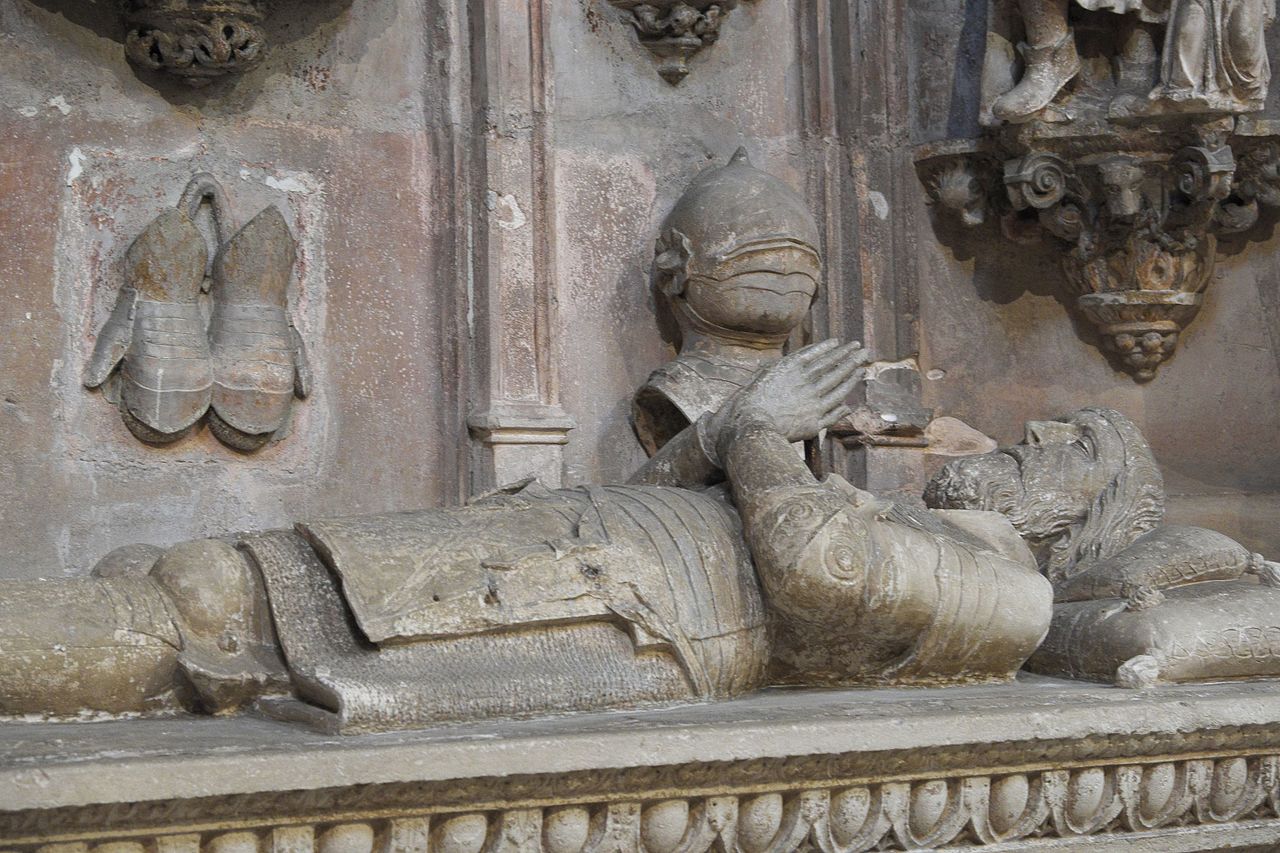
In the dim light of the nave stand the tombs of King Afonso Henriques and King Sancho I, masterpieces carved by Nicolau Chanterene around 1520. Each lies in eternal repose, their faces serene, their hands folded in prayer.
The detail is exquisite, with folds of robes, shields, inscriptions, and angels surrounding the effigies. The sculptor captured not only likeness but also essence: the steadfastness of rulers who built a nation from faith and will.
Their tombs flank the main altar like guardians of the kingdom they created. Between them rises the high altar, crowned by an ornate retable glowing with gilded carvings. It’s not hard to imagine the solemn coronation masses that once echoed through these halls.

The Cloister of Silence
Every monastery hides a cloister, and Santa Cruz’s is among the most beautiful in Portugal.
Designed by Diogo de Boitaca, who also worked on the Jerónimos Monastery in Lisbon, the Cloister of Silence was built between 1522 and 1530. Its symmetry and harmony are remarkable, a geometric poem in limestone.
Arcades of slender columns form a perfect square around a central fountain, once used for ritual washing. Sunlight spills through arches, tracing patterns on the stone floor, and a sense of calm pervades the air.
The name “Cloister of Silence” isn’t a poetic exaggeration; it was literally a place of silence. Here, monks meditated, read scripture, and walked in contemplation. Centuries later, it still feels like a place where time has paused.

A Legacy of Learning
It’s impossible to separate Santa Cruz from Coimbra’s intellectual tradition. The monastery’s library, once one of the finest in medieval Portugal, contained hundreds of illuminated manuscripts and theological works. Many were later transferred to the University of Coimbra, where they inspire scholars today.
Several of the monastery’s canons went on to teach at the university, and its early curriculum—a blend of theology, law, and philosophy—was shaped by monastic scholarship.
In short, Santa Cruz helped shape Portugal long before Coimbra was known as the “city of students.”
Saint Theotonius: The Soul of Santa Cruz
At the heart of the monastery’s spiritual legacy lies Saint Theotonius, Portugal’s first canonized saint. A man of humility and learning, he served as the monastery’s first prior and as a close spiritual adviser to King Afonso Henriques.
His life embodied the virtues of the Augustinian order—charity, devotion, and contemplation. When he died in 1162, miracles were said to occur at his tomb, and his canonization soon followed.
To this day, his relics still rest within the monastery, and pilgrims come to pay homage to the saint who helped guide the conscience of a young kingdom.

Art, Power, and Piety
The Monastery of the Holy Cross is a treasure chest of artistic heritage. The Sacristy, with its gilded woodwork and intricate azulejos, reflects the baroque tastes of later centuries. The Chapter House, where monks once gathered to discuss the governance of their community, still echoes with its solemn purpose.
One of the most extraordinary features is the baroque organ, richly decorated with gold leaf and carved angels. When played during services, its sound fills the vaulted space with vibrations that seem to reach beyond time.
In every detail, from the ribbed ceilings to the stone carvings of mythical creatures, the monastery tells a story of Portugal’s evolution: from a medieval stronghold of faith to a Renaissance powerhouse of art and knowledge.
Coimbra: A City That Grew Around It
Santa Cruz isn’t just a monument; it’s a living part of Coimbra’s urban and cultural fabric. Step outside its gates, and you’ll find yourself in Praça 8 de Maio, one of the city’s most charming squares. Cafés spill out onto the cobblestones, students from the university stroll by with guitars slung over their shoulders, and the air carries the scent of roasted chestnuts and coffee.
From here, it’s an easy walk to other historic landmarks: the Old Cathedral (Sé Velha), the Machado de Castro Museum, and the steep lanes leading up to the University of Coimbra.
Every corner of the old town seems to bear Santa Cruz’s imprint, in its architecture, in its rhythm, and in the way Coimbra’s history always circles back to its sacred beginning.

A Living Monument
Despite its age, the Monastery of the Holy Cross remains an active place of worship. Daily masses are held in the church, and concerts often take advantage of its remarkable acoustics.
Visitors can explore most of the monastery’s spaces independently or on guided tours. The Treasury Museum inside displays religious artifacts, vestments, and manuscripts, offering a tangible connection to its monastic past.
And if you pause in the courtyard café after your visit, with a cup of bica and a pastel de nata, you might notice how the rhythms of modern Coimbra flow seamlessly around this ancient heart. The students, the bells, and the tourists all coexist with the quiet dignity of the stones.
Santa Cruz doesn’t just preserve history; it lives it.
Visitor Information
Location: Praça 8 de Maio, 3001-300 Coimbra, Portugal
Opening Hours: 9:00 AM – 5:30 PM (closed for lunch; check seasonal variations)
Entry Fee: Approximately €3–5; discounts for students, seniors, and groups
Website: Visit Coimbra Tourism Office
Getting There:
From Lisbon or Porto, take a Comboios de Portugal (CP) train to Coimbra-B Station. From there, a short local train or 10-minute walk brings you to the old town. The monastery is centrally located on Praça 8 de Maio, within easy reach of most major sights.
Nearby Highlights:
- Sé Velha (Old Cathedral)—A Romanesque gem of the 12th century
- Machado de Castro National Museum – Built over ancient Roman ruins
University of Coimbra—A UNESCO World Heritage Site

Why It Matters
The Monastery of the Holy Cross is more than a stop on a sightseeing itinerary. It’s a bridge between Portugal’s medieval origins and its modern identity, a reminder that the nation began not only with conquest but also with faith, art, and learning.
Here’s the thing: when you stand before the tomb of Afonso Henriques, you’re not just looking at a piece of stone. You’re standing at the cradle of a country. The same stone that once felt the echo of monks’ footsteps now feels yours.
Few places capture the continuity of Portugal’s spirit as vividly as Santa Cruz.
A Moment to Remember
If you visit, go early in the morning. The air is cooler, the light softer, and the crowds still far away. Sit quietly in the nave for a few minutes. Watch the sunlight drift across the marble floor and touch the effigy of a king who changed history.
Outside, life goes on: the café chatter, the hum of traffic, and the laughter of students. Inside, time still bends around those who built, prayed, ruled, and dreamed within these walls.
That’s the magic of the Monastery of the Holy Cross. It isn’t trapped in the past. It’s part of the present, quietly reminding Portugal who it is and where it began.