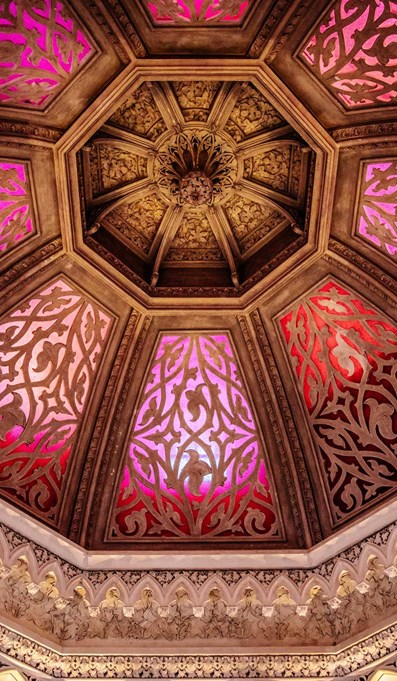
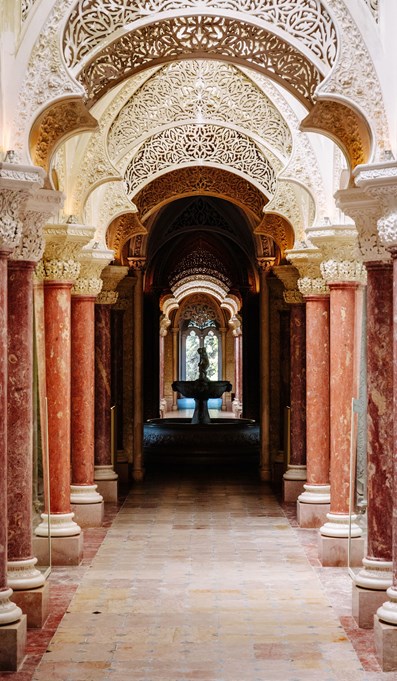
Monserrate, as a writer’s hideaway, drew a large number of international tourists, particularly the British, who lauded its beauty in their trip tales and engravings. When Francis Cook, a wealthy nineteenth-century British manufacturer and an avid collector of art, paid a visit here, he was enchanted. This enthusiasm resulted in a Romantic masterpiece: the Park and Palace of Monserrate.
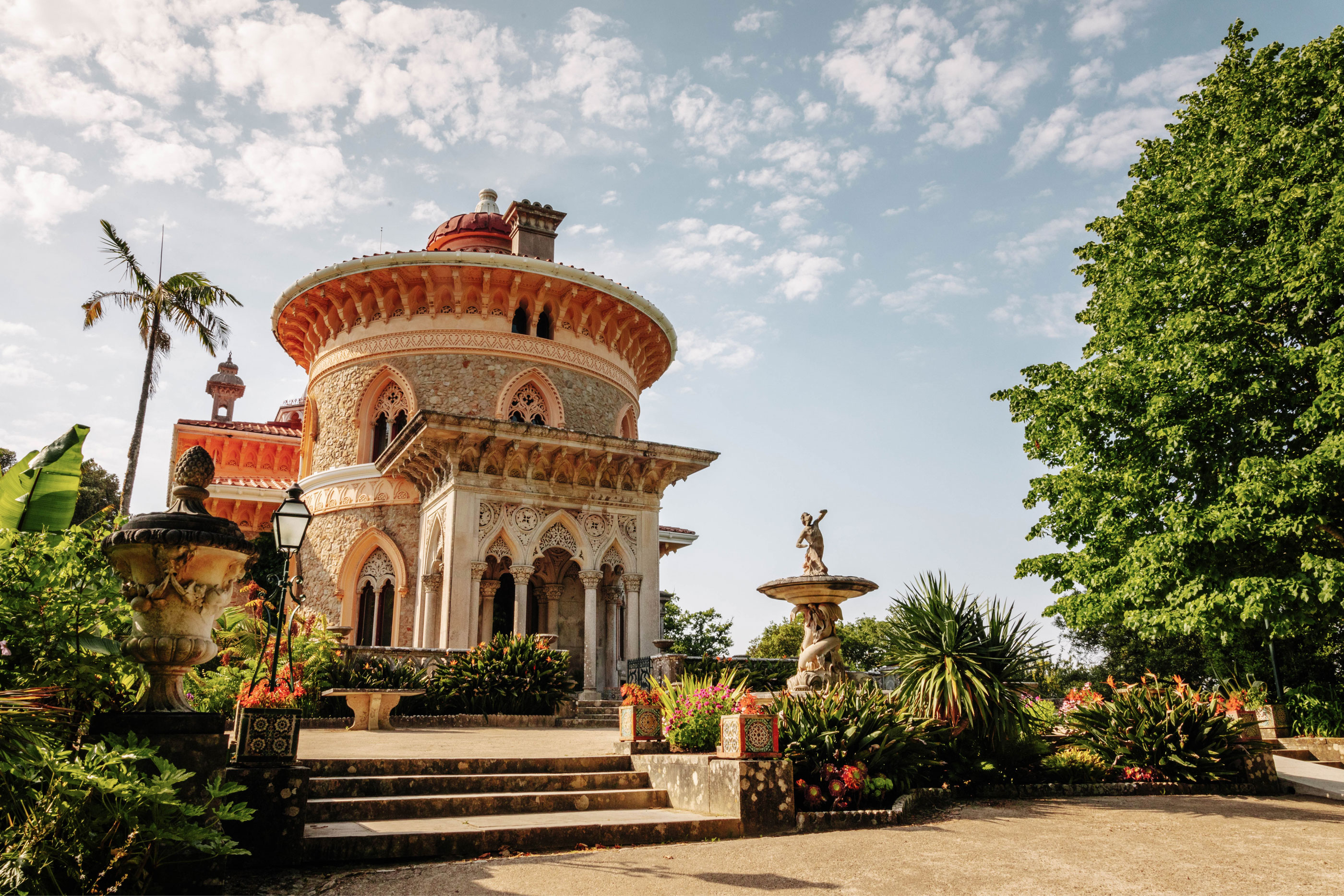
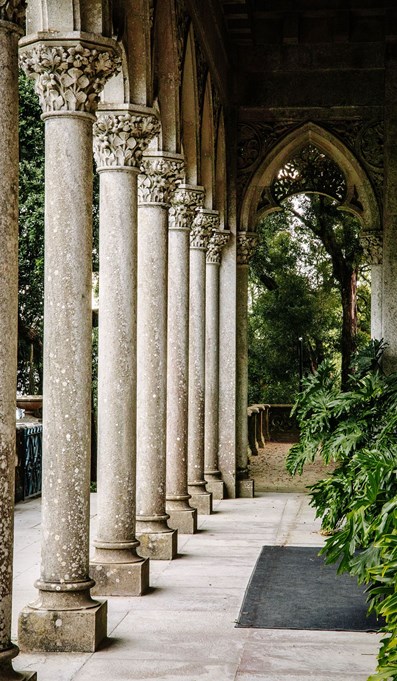
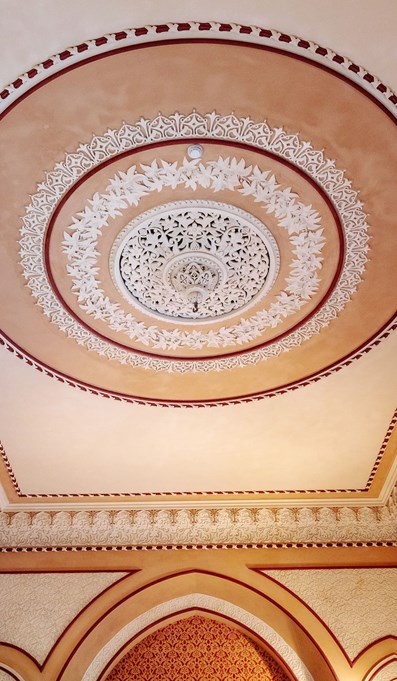
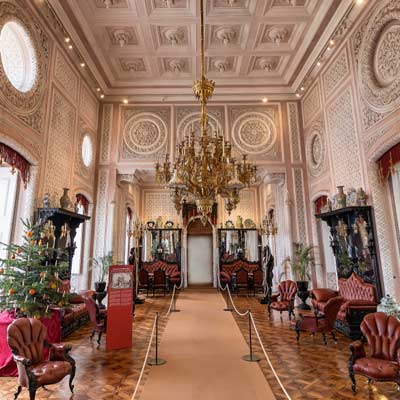
Francis Cook realised his dream by transforming Monserrate into what it is today, with its exuberant gardens – capable of astonishing visitors with exotic species sourced from every corner of the globe – and a palace that is a true ode to romantic architecture, reflecting Francis Cook’s refined taste and the genius of its architect James Knowles Jr., who combined various influences here.
However, the history of this endearing location is dotted with several vicissitudes. Monserrate hides a multitude of diverse pasts behind its wonderfully crafted walls, all of which glorify its natural beauty.
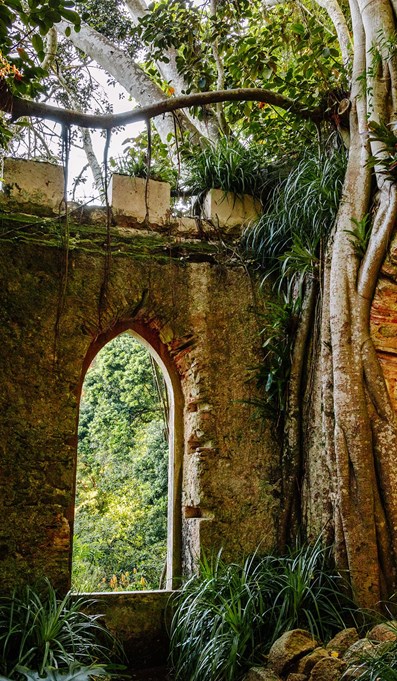
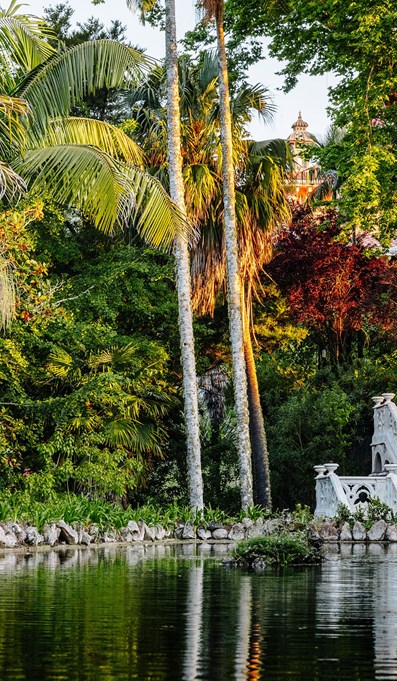
The Park of Monserrate, one of Portugal’s most notable Romanticism-inspired landscapes, has received species from all over the world, which have been structured into geographic areas to reflect the plants’ diverse origins and to create distinct scenarios along the pathways that connect the ruins, lakes, and waterfalls. This was made possible, in part, by the involvement of landscape designer William Stockdale, botanist William Neville, and master gardener James Burt, but most importantly, by Francis Cook’s romantic spirit, which allows us to encounter such contrasting scenarios today in the Park of Monserrate, growing alongside indigenous species such as the tree-sized arbutus, the already extremely rare species of holly, and the imposing juniper.
The palace was built in 1858 under the direction of Sir Francis Cook, Viscount of Monserrate. It was designed by architects Thomas James Knowles (father and son). The gardens were built to take advantage of the Mountain’s microclimate, resulting in a spectacular park with over 3000 exotic plants still visible today.
The palace served as the Cook family’s vacation retreat and was erected over the ruins of a neo-Gothic mansion built by English trader Gerard de Visme, who was also responsible for the original Montserrat palace. In 1793, William Beckford rented the property, began repairing the palace and began establishing a beautiful garden.
Along with other palaces in the neighbourhood, such as Pena Palace, it is a stunning example of Portuguese Romanticism. Since 1978, it has been designated a Monument of Public Interest.
Lord Byron, the Anglo-Scottish poet and major figure of the Romantic Movement paid a visit to the Monserrate Palace in 1809. The property’s exquisite beauty inspired the poet in Childe Harold’s Pilgrimage, making it a must-see for foreign travellers, but especially for English travellers, who have described it in countless trip tales and recorded it in engravings.
Esperança, Portugal, is home to one of the world’s shortest international bridges. This petite bridge spans only 10.4 feet (3.2 metres), connecting Spain’s La Codosera municipality with Portugal’s Arronches. The European Union funded its construction in the early 2000s, employing workers from both countries.
Primarily used by pedestrians, the bridge is also suitable for two-wheeled vehicles. Despite its size, it serves as a significant link between the two nations, promoting local cross-border movement and cooperation.
While some mistakenly attribute the title of the world’s shortest international bridge to the Zavikon Island bridge between the United States and Canada, the bridge between Spain and Portugal is shorter by about 13 feet (4 metres). This small yet crucial piece of infrastructure exemplifies how even the smallest connections can have meaningful impacts on international relations.
Esperança, Portugal: The World’s Shortest International Bridge
Location:
Esperança is a parish in the municipality of Arronches, Portugal.
Spain: La Codosera municipality
Dimensions and Structure:
Length: 10.4 feet (3.2 metres)
Construction: Wooden
Built by workers from both Spain and Portugal
Funded by: The European Union in the early 2000s
Usage:
Primarily for: Walkers (pedestrians)
Also suitable for two-wheeled vehicles (e.g., bicycles, motorcycles)
Significance:
Cultural and practical impacts:
It facilitates easy and direct cross-border movement for residents.
The program promotes cooperation and good relations between the neighboring regions of Spain and Portugal.
Unique Fact:
Sometimes, people mistakenly claim that the Zavikon Island bridge, which spans the United States-Canada border, is the world’s shortest international bridge. However, the bridge between Esperança, Portugal, and La Codosera, Spain, is shorter by at least 13 feet (4 meters).
Additional Information:
Tourism and Local Interest:
The bridge is a charming attraction for visitors interested in unique and lesser-known international connections.
It provides an interesting backdrop for photographs and a tangible representation of the close relationship between the two countries.
Economic and social impacts:
It enhances local economies by facilitating easier movement of people for work, shopping, and social visits.
It strengthens cultural ties by enabling more frequent and easier interactions between communities on either side of the border.
Visiting the Bridge:
How to get there:
From Portugal:
Travel to the parish of Esperança in the municipality of Arronches.
Follow the local signs and directions to the bridge.
From Spain:
Travel to La Codosera municipality.
Follow the local signs and directions to the bridge.
What to expect:
A short walk across the wooden bridge enters another country.
The scenic surroundings offer a peaceful and picturesque setting for your visit.
You can experience the unique charm of crossing an international border in just one small step.
This small yet significant bridge stands as a testament to the strong ties between Portugal and Spain, showcasing how infrastructure, no matter how small, can play a vital role in connecting people and fostering international goodwill.
This magnificent Portuguese palace appears to be a mash-up of many castles.
“For any proud Portuguese & curious foreigner, a visit to Pena Palace is a must”
The Pena National Palace, located on a lush hill in São Pedro de Penaferrim, Portugal, is a prominent national monument that appears to have been formed by combining towers, facades, and architectural flourishes from a variety of various castles.
The palace, built in the nineteenth century by King Ferdinand II, was intended to serve as a summer residence for the Portuguese royal family. Ferdinand’s extravagant preferences were pressed on the builders and designers, resulting in a schizophrenic mansion that appeared to satisfy any and all of the king’s transitory desires from the outside. A section would be fashioned after a mediaeval European castle with beautiful parapets, while the next section would be modelled after an Islamic tower dome. Each part of the facade is also coloured differently; a long purple wing is flanked by a red clock tower and a yellow minaret, for example. It is today regarded as a magnificent example of Romantic architecture.
The palace’s interior was no less magnificent or diverse. Numerous rooms have been built to represent a particular cultural influence, ranging from Middle Eastern to European Baroque styles.
When Portugal’s royal family departed the country following the 1910 Revolution, the palace and its gardens fell into ruin. However, the complex was restored in the latter part of the twentieth century and is now a UNESCO World Heritage site. The palace is now open to any person willing to make the walk, which is well worth it given that visitors get to explore a whole universe of architecture in one stop.
Guimarães, a historic town in the north of Portugal, is known for its significant role in the emergence of the Portuguese national identity in the 12th century. It is said that the first king of Portugal, Afonso Henriques, was born in Guimarães, and it was also the site of the Battle of São Mamede, which marked the beginning of the independence of Portugal from the Kingdom of León.
An exceptionally well-preserved and authentic example of the evolution of a medieval settlement into a modern town, Guimarães offers visitors a unique insight into the history and culture of Portugal. Its rich building typology exemplifies the specific development of Portuguese architecture from the 15th to 19th century, with consistent use of traditional building materials and techniques. The Old Town of Guimarães is a UNESCO World Heritage Site, and they consider it one of the most important historical centres of the country.
The town is known for its lively atmosphere and cultural events. Visitors can enjoy a variety of festivals and events throughout the year, such as the Festival Internacional de Teatro de Guimarães, the Festival de Inverno, and the Feira de São Mateus. Besides the historical and cultural attractions, Guimarães also offers a range of outdoor activities, including hiking, cycling, and bird watching.
Overall, Guimarães is a must-see destination for those interested in the history and culture of Portugal and offers a unique blend of traditional and modern experiences for visitors.
The historical centre within the Guimarães city walls is related to the establishment and identity of Portugal, and it was designated a World Heritage site based on the uniqueness and authenticity with which it was restored. The city still maintains a beautiful, well-preserved legacy, as seen by the exquisite iron verandas, granite balconies and porticos, mansions, arches linking the small streets, time-worn pavement slabs, towers and cloisters. For a minute, imagine yourself in a mediaeval environment, where the nobles erected their mansions throughout time, such as the Mota Prego house, the Vila Flor and Toural palaces, and the many others that give Guimarães its distinct character.
Begin at the city’s centre, Largo da Oliveira, where you’ll discover the Padrão do Salado and the Collegiate Church of Nossa Senhora da Oliveira, which houses the important Alberto Sampaio Museum. Passing through the Paços Municipais (City Hall), covered with battlements, enters the Praça de Santiago, which greeted pilgrims headed for Compostela in the Middle Ages, just as it welcomes inhabitants and visitors now in its cafés and terraces. The Convent of Santa Clara, the Casa do Arco, and other beautiful homes may be found in Rua da Santa Maria, which connects the upper and lower cities.
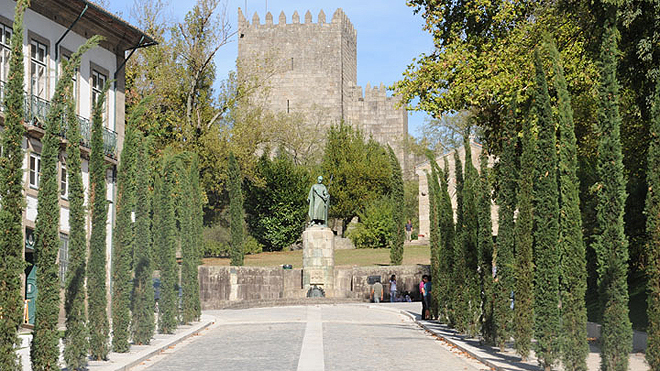
Go along this street, or the Avenida Alberto Sampaio, which is bordered by the ruins of an old wall that extends into the upper city, between the Palace of the Dukes of Bragança and the castle. On your way to the castle at the top, you will pass by this palace, a 15th-century monument with French seigneurial architecture influences, the Monument to King Afonso Henriques, the Romanesque Chapel of S. Miguel, and finally the Castle, which dates back to the 10th century and is closely linked to the foundation of Portugal.
But you must also see another key place in Guimarães, so return to the Largo do Toural, which features a 16th-century fountain. Rua D. João I, which was on the road to Porto in the Middle Ages, has historic residences with wooden balustrades and a 17th-century façade. The neo-Romanesque Martins Sarmento Archaeological Museum, which extends into the Convent’s cloister, is found around the Church of the Convent of S. Domingos, presently in Rua de Paio Galvão. Just ahead is the historic market hall structure, which now houses the José de Guimarães International Arts Centre, which features a retrospective of the work of this internationally known artist, who was born in the city.
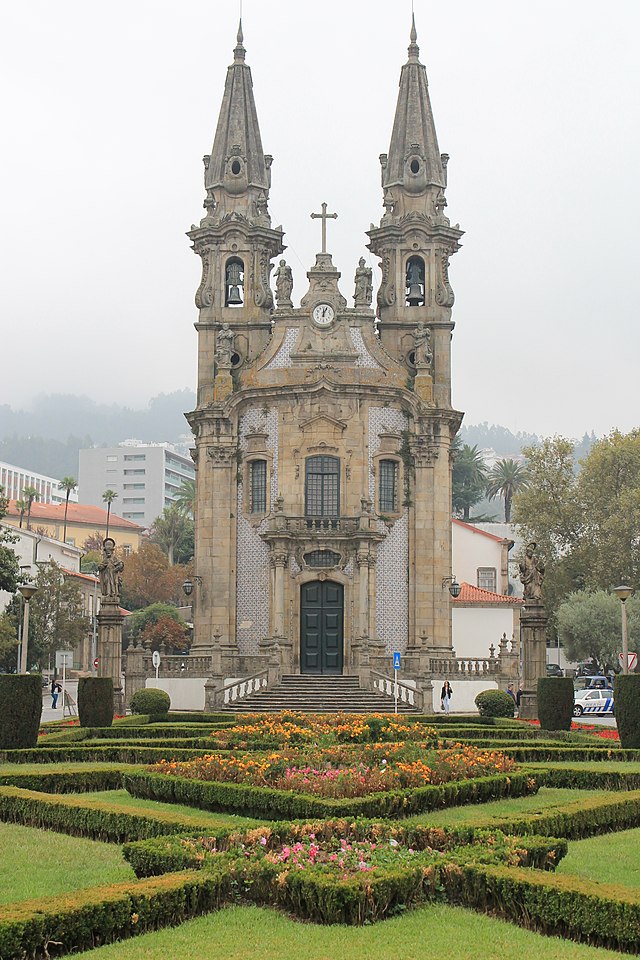
Further out from the city centre, the Vila Flor Palace and Cultural Centre’s flowing gardens with Summer Houses and rocaille ornamentation are well worth a visit, as is the Baroque Church of Nossa Senhora da Consolação e dos Santos Passos at the far end of Largo da Republica do Brasil.
For a different perspective on the city, take the cable car up to Monte da Penha, where you will discover the Shrine of Our Lady of Penha and one of the most stunning vistas in northern Portugal.
Things To See And Do In Guimarães
Square Largo da Oliveira
The communal plaza of Largo do Oliveira, named after a centuries-old olive tree placed here, is one of the city’s cultural focal points, along with the adjoining Largo da Sao Tiago. The area is surrounded by classic Portuguese buildings, with a stunning gothic shrine in the centre. This was erected during Alfonso IV’s rule to commemorate the battle of Salado, in which Portuguese and Castilian forces defeated the Moorish army in 1339.
Citania de Briteiros
Citania de Briteiros, home to numerous historic riddles, is supposed to have been the location of a Castro culture community going back to the 1st and 2nd centuries BC. It appears to have lasted into the Middle Ages. This is an excellent place to visit if you want to learn more about how earlier Iberian communities interacted with their surroundings. It is the site of several significant findings in northern Iberia.
Guimarães Castle
No visit to Guimarães is complete without seeing its most magnificent and colossal landmark, the Guimarães Castle. The castle is a symbol of the region’s power. It is a cultural gem that draws a great number of people each year. Whether you want to stand in its magnificent shadow and enjoy the castle from below, or scale its defences and see the city from above, this is a must-see for any visitor.
Rua de Santa Maria
Rua de Santa Maria, one of Guimarães’ most ancient and culturally significant avenues, is home to a number of mediaeval architectural marvels. Walk along the street to feel as though you’ve stepped back in time. There are also a number of restaurants and stores on the street. It is the ideal location for seeing the city’s splendour while shopping or dining at one of the restaurants.
Igreja de Sao Francisco
The São Francisco Convent and Church is a significant architectural and historical element of Portuguese identity. It is a permanent relic of the Franciscan order in Guimarães. The church is an excellent example of architectural fusion. These include gothic and mannerist styles, as well as a variety of others that have been altered through many centuries to produce the wonderful combination that can be seen today.
Serra Penha
The Serra Penha, one of Northern Portugal’s most stunning natural monuments, is regarded as Guimarães home mountain. This gigantic granite mountain towers over the city at over 600 metres in height. The summit has a number of activities available, including mini-golf, as well as a statue honouring Pius IX. Climb the peak to get a birds-eye perspective of the surrounding area.
Jardins do Palaci de Vila Flor
The gardens and palace of Vila Flor are identified as one of the starting sites for Guimarães cultural superiority. The Jardins do Palacio de Vila Flor are a wonderful illustration of how human innovation and natural beauty can coexist in harmony. The gardens are a pleasant hideaway and a relaxing area from which to take in the splendour of Guimarães.
Nothing beats being able to venture into town without breaking the bank. Whether it’s visiting museums or admiring breathtaking scenery. There is something here for everyone. Cascais offers plenty to enjoy without spending a cent—from wandering cobbled streets and relaxing on golden beaches to strolling the coastal path to Estoril, exploring Boca do Inferno’s cliffs, and unwinding in Marechal Carmona Park.
Town Museum
Any visit to Cascais should include a visit to the “Museu da Vila”, a free-admission museum dedicated to the town’s history. It tells a story of the people who lived in the area before the formation of Portugal (pre-12th century), the birth of Cascais and the significance of its coat of arms, the importance of fishing and agriculture, life following the Lisbon earthquake of 1755, and the years when it became the Portuguese Riviera. A fascinating journey with some interactive elements.
Address: Praça 5 de Outubro 1, 2750-320 Cascais, Portugal
Relax on Cascais Beach: There are several beaches in Cascais, free to visit. Pack a picnic and spend the day soaking up the sun and enjoying the sea
Cascais beaches
Praia da Rainha
Praia da Duquesa
Praia da Conceição
Tamariz Beach
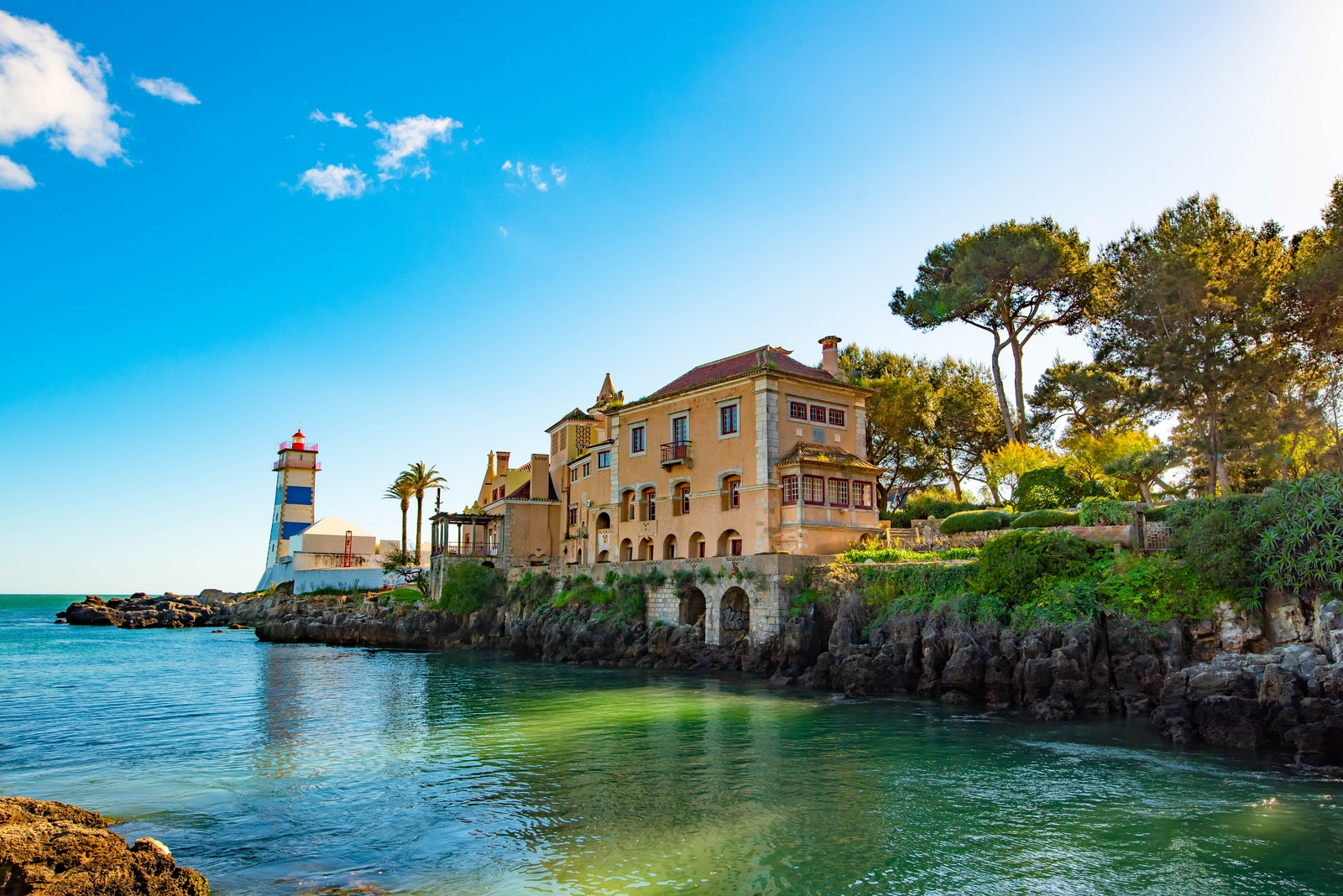
Praia de Santa Marta
Ribeira Beach
Praia da Rata (Praia das Moitas)
Praia da Poça
Praia do Guincho
Praia de São Pedro do Estoril
Cascais Wi-fi
A stroll around the lovely old town centre in the post-beach glow will feel fantastic, as long as you overlook the salt and sand coating your body. Utilize the Cascais WI-FI network to feed your Instagram – but be careful not to overdo it with the downloads.
Cascais Tide Gauge
Cascais received an observatory for researching tides in 1882, courtesy of Amédée Phillipe Borrel, a French watchmaker. Surprisingly, the system continues to function to this day. In 1895, the Cascais Tide Gauge (“Marégrafo”) was relocated to its current site, atop a natural rock formation and on the most stable available platform. “The tidal gauge records have been maintained without interruption for almost 120 years,” explains José Manuel Campos of the state heritage office, who is responsible for the Tide Gauge’s maintenance. Seven days a week, the analogue system monitors the tides and records data on a piece of paper using a pen (various colours, changed during the week). The resultant image is referred to as a “maregrama” (“tidegra”). “In the past, this was a full-time job for someone,” Campos explains. Additionally, the Cascais tide gauge created the Portuguese Altimetric Datum (zero-level elevation), which is used as a reference for height measurements in Portugal. This implies that if you ascend to the highest peak in adjacent Sintra – 528 metres above sea level – your altitude is determined by this sea gauge. Of the four analogue sea gauges that originally existed in Europe (the others were in France, the Netherlands, and Scotland), this is the only one that is still operational and accessible to the public.
Avenida Maria Pia de Sabóia, Cascais
www.cascais.pt/equipamento/maregrafo-de-cascais
Guided tours, Tue-Thu 3pm
Citadel Art District
If you have an interest in the arts, you really must visit the Citadel Art District, which features galleries, art studios, and project space where local artists exhibit their work. Art pervades the whole complex, from the rooms to the corridors of the Pestana Cidadela Cascais Hotel, and new exhibitions open regularly. Visit and learn about this cultural movement.
Palácio da Cidadela de Cascais, Av. D. Carlos, Cascais
Opening hours: Tue-Sun 10am-6pm
Marechal Carmona Park
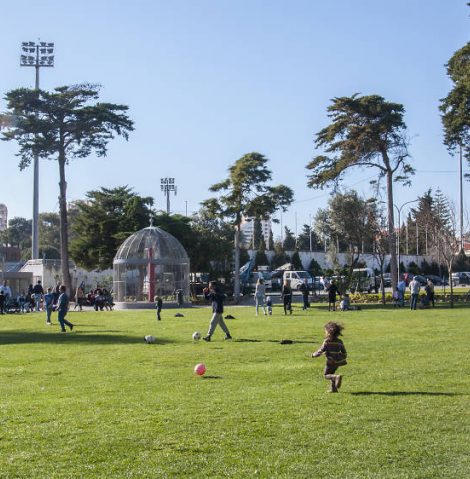
One of Cascais’s green lungs, formed in the 1940s by the merging of the gardens of the Condes de Castro Guimares Palace (the same-named museum is located nearby) and grounds owned by the Gandarinha Viscount. The park has a romantic vibe to it, with several secluded spaces for lovers, but it is also fantastic for children, with two playgrounds (one for toddlers and one for older children), peacocks, ducks, roosters, chickens, and a spacious lawn for sunbathing.
The most renowned stone structure in Cascais attracts many visitors who walk atop the boulders each day to peer out over the sea and attempt to get the greatest shot possible as a souvenir. Walking across the rocks to the viewpoint is a pleasant walk; from there, you can appreciate the ocean’s real might, even on calm days. A Portuguese arts and crafts market is nearby, open every day until 9 p.m.
Explore the Cascais Marina: The marina is a bustling hub of activity, and it’s free to stroll around and admire the boats. There are also plenty of cafes and restaurants nearby if you want to grab a bite to eat.
Walk along the Cascais Promenade: The promenade runs along the coast and offers gorgeous views of the ocean. It’s a great place to take a leisurely stroll and people-watch.
Visit the Casa das Historias Paula Rego: This museum is dedicated to the work of Portuguese artist Paula Rego, and it’s free to visit on Sundays.
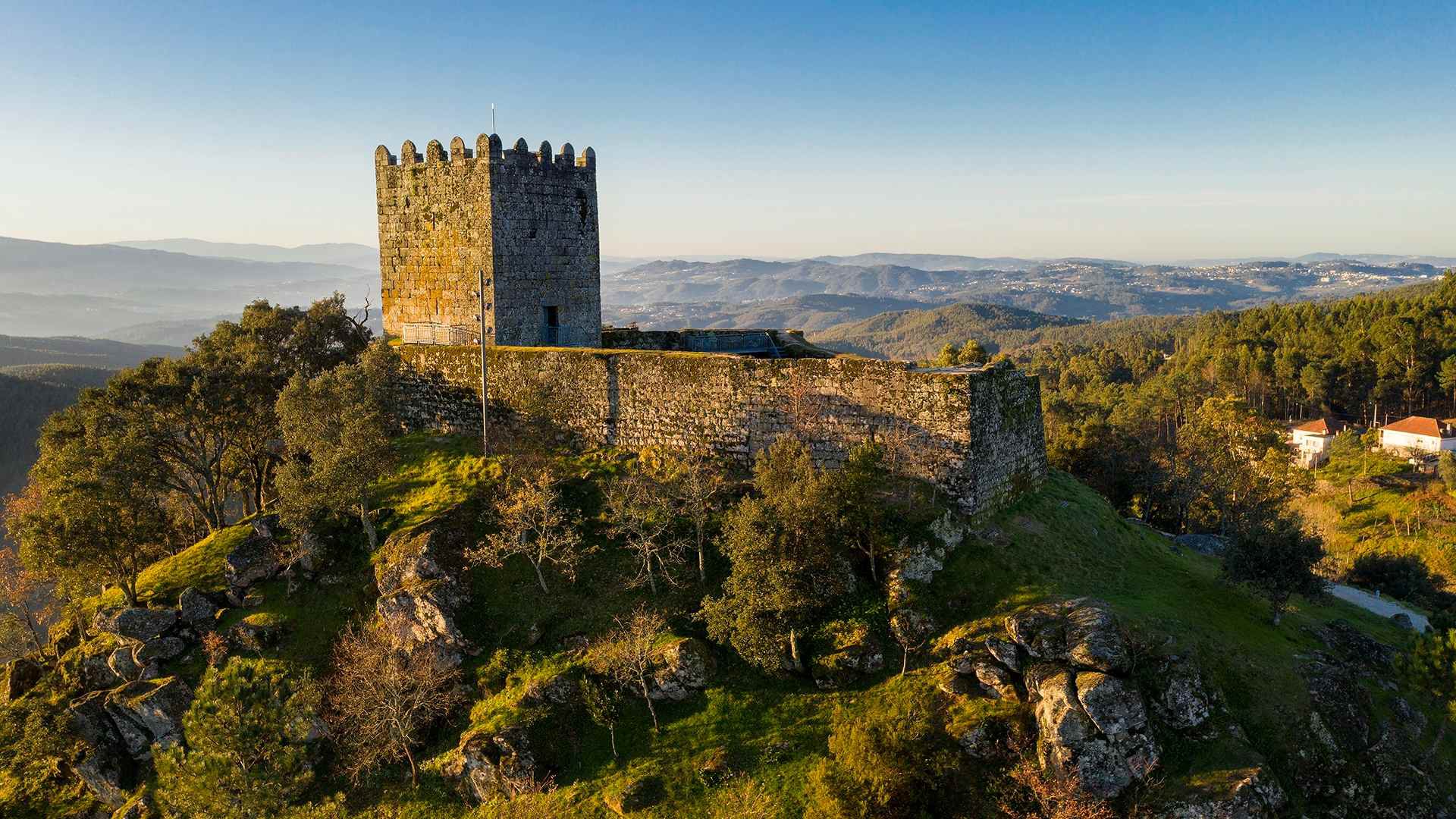
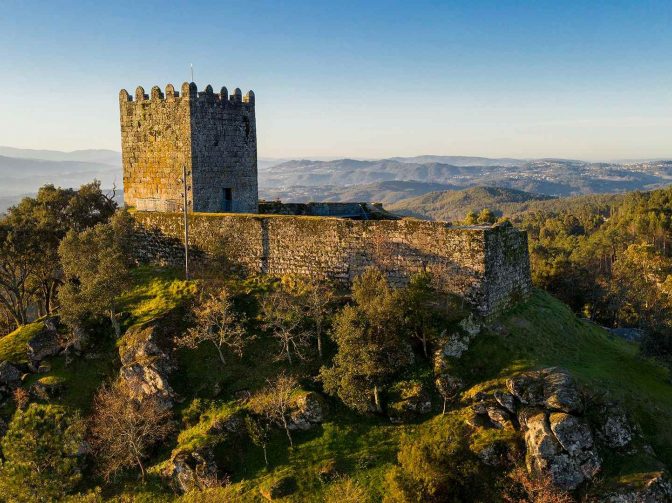
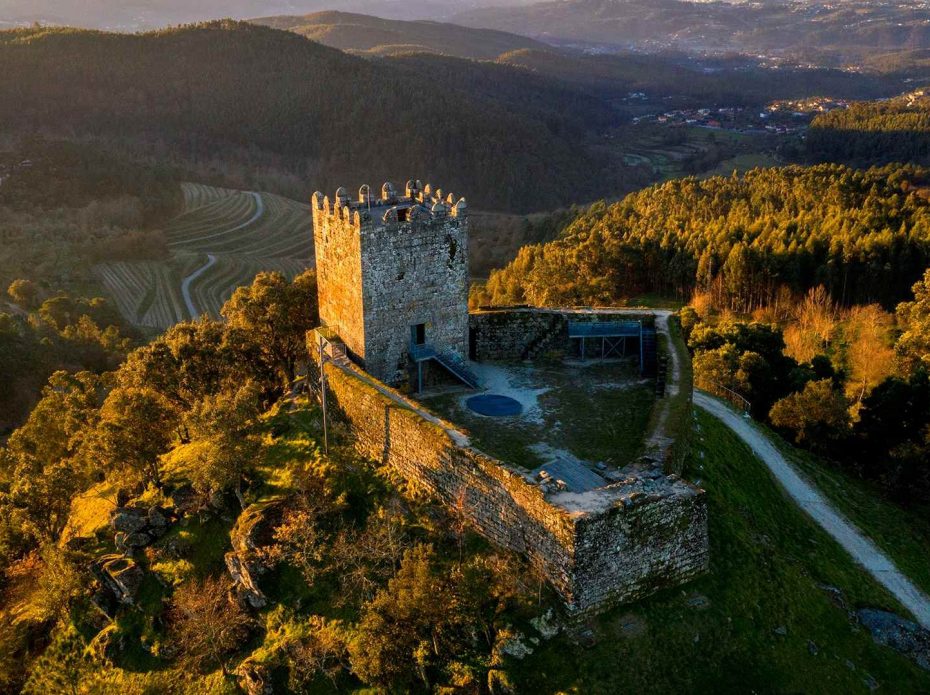
The Castle of Arnóia is a medieval castle in the civil parish of Arnóia, municipality of Celorico de Basto, the district of Braga. It is classified as a National Monument.
This Romanesque Castle, once located in Terra de Basto, is part of Europe’s castling movement that spanned the 10th and 12th centuries.
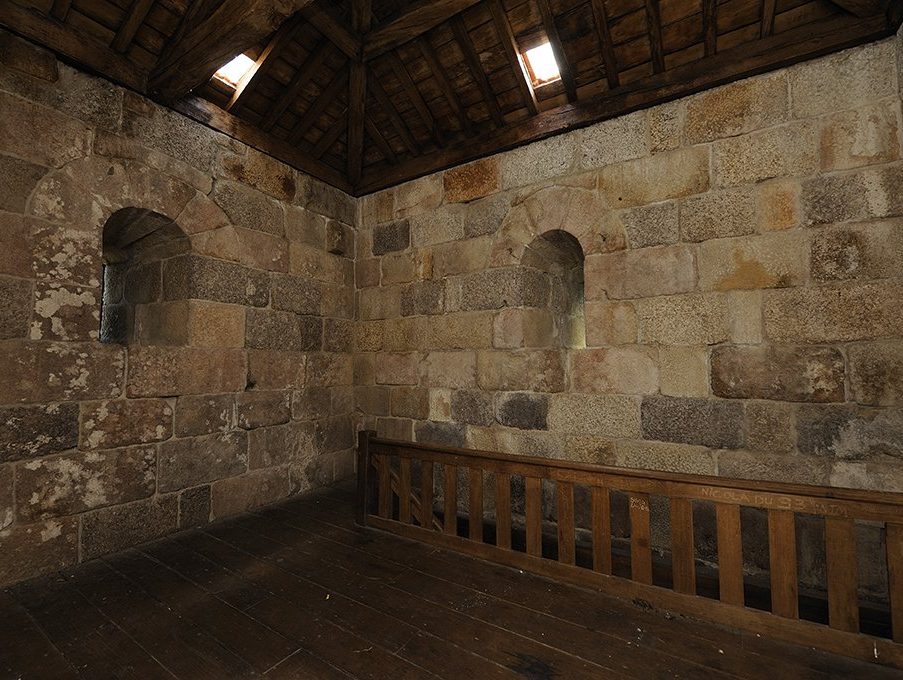
The watchtower (whose rooftop and set of battlements were restored in the twentieth century), the quadrangular tower, a single door, and the tank are the four defensive pieces that stand out on top of a hill.
Archaeological traces from the fort’s occupancy between the 14th and 16th centuries were discovered.
It is now time for the edifice to deteriorate, which in peacetime was only a symbol of administrative and lordly power that patronised the region.
The abandonment began in 1717, when the elites departed the little village of Basto, relocating the county seat to the parish of Britelo, where Celorico de Basto is now located.
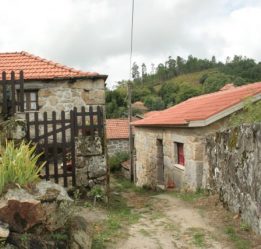
The legacy of the little town of Basto lives along the branch path that connected the old road of Lixa to the main route of Amarante-Arco de Balhe, which is designated as the present-day settlement of Castelo.
The pillory, the hearing house, and the chemists are all indicative of the bustling roadway along which the village grew.
How to get here:
41.363536, -8.051996
Lugar do Castelo, Arnoia, Celorico de Basto, Braga
10th century (2nd half) – Edification of the Castle of Arnoia, according to tradition;
1064 – First documented reference regarding the fortification;
1092 – A document mentions the properties of Celorico and Terra de Basto;
12th-13th centuries – Second occupation period of the Castle and edification of the Castle of Arnoia’s Romanesque structure ;
1717 – The parish seat is transferred from Vila de Basto to the parish of Britelo;
1726 – The Terra de Basto was by then divided into two municipalities, Celorico and Cabeceiras de Basto. The Castle of Arnoia’s keep still showed its crenellation crown;
1758 – The Castle of Arnoia was already presenting some traces of ruin;
1946 – It is classified as a National Monument by Decree no. 35,532 (Governmental Gazette no. 55, from March 15th);
1960-1963 – Period of restoration works in the Castle of Arnoia, under the responsibility of the DGEMN – Direção Geral dos Edifícios e Monumentos Nacionais [General Directorate for Buildings and National Monuments];
1985 – The Castle of Arnoia is attached to the IPPC – Instituto Português do Património Cultural [Portuguese Institute of the Cultural Patrimony];
1992 – The Castle of Arnoia’s jurisdiction is transferred to the IPPAR – Instituto Português do Património Arquitetónico [Portuguese Institute of the Architectonic Patrimony];
2002 – Archaeological surveys were carried out inside the fortification;
2004 – Installation of the Interpretive Centre of the Castle of Arnoia;
2005 – The Castle of Arnoia is reallocated to the IGESPAR – [Portuguese Institute for Management of Architectural and Archaeological Heritage];
2010 – Integration of the Castle of Arnoia in the Route of the Romanesque;
2014 – Improvements to the surroundings of the Castle of Arnoia, under the scope of the Route of the Romanesque;
2015 – Intervention for the conservation and protection of the inside and outside of the Castle, under the scope of the Route of the Romanesque;
2020 – The Portuguese State transfers the responsibility of management, promotion and conservation of the Castle of Arnoia to the Municipality of Celorico de Basto.
What to See and Do Around The Castle of Arnóia
Castelo – Village
The history of this location may be imagined along the lines of its legacy, whether in the residential buildings, the House of Justice and Jail, the former pharmacy, or the pillory. The Castle, keeper of legends and stories, provides a great perspective of the village and surrounding landscape, as well as a stunning belvedere overlooking the Tâmega and Infesta valleys.
Vila River Beach
During the summer, the Vila river beach is quite popular, as it is located in a very comfortable environment. It is located in Celorico de Basto’s urban region, adjacent to the Freixieiro Urban Park and Camping Site.
Freixo Lagoon and Leisure Park
In the summer, the Freixo Leisure Park is very popular. It has an artificial lagoon with a picnic area, a beach soccer field, and a terrace bar.
Monastery of Saint Benedict of Arnoia
A longitudinal church with a single nave and a smaller square chancel, a square bell tower attached to the north section of the main façade, and monastic dependencies attached to the south, advanced in relation to the main façade and organised around a square cloister; their south section is extended to the west, forming a L around the patio.
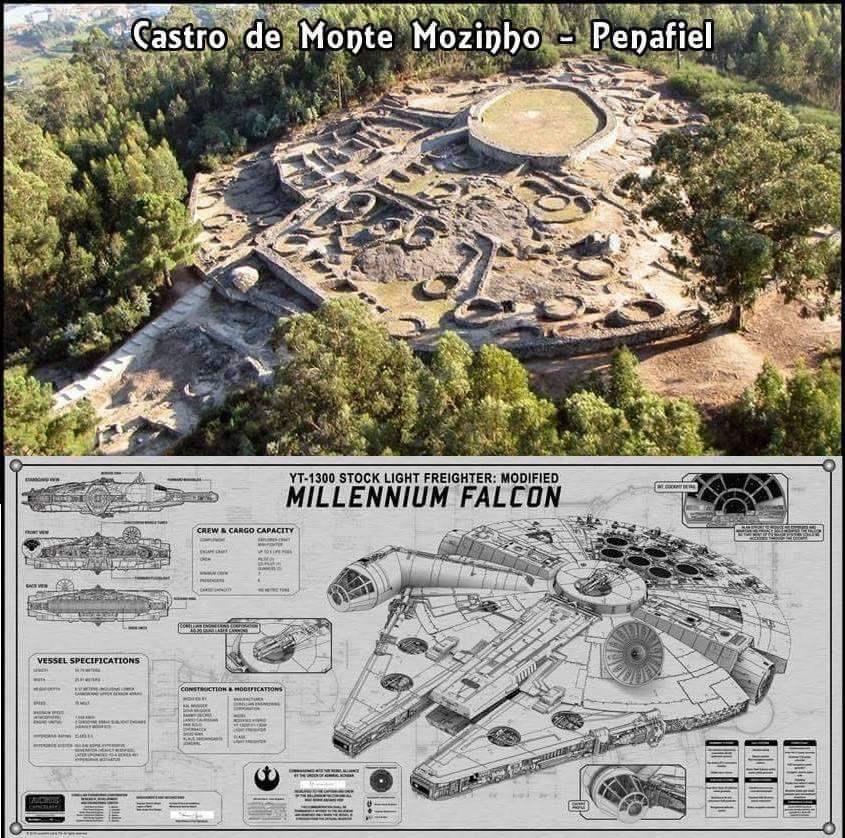
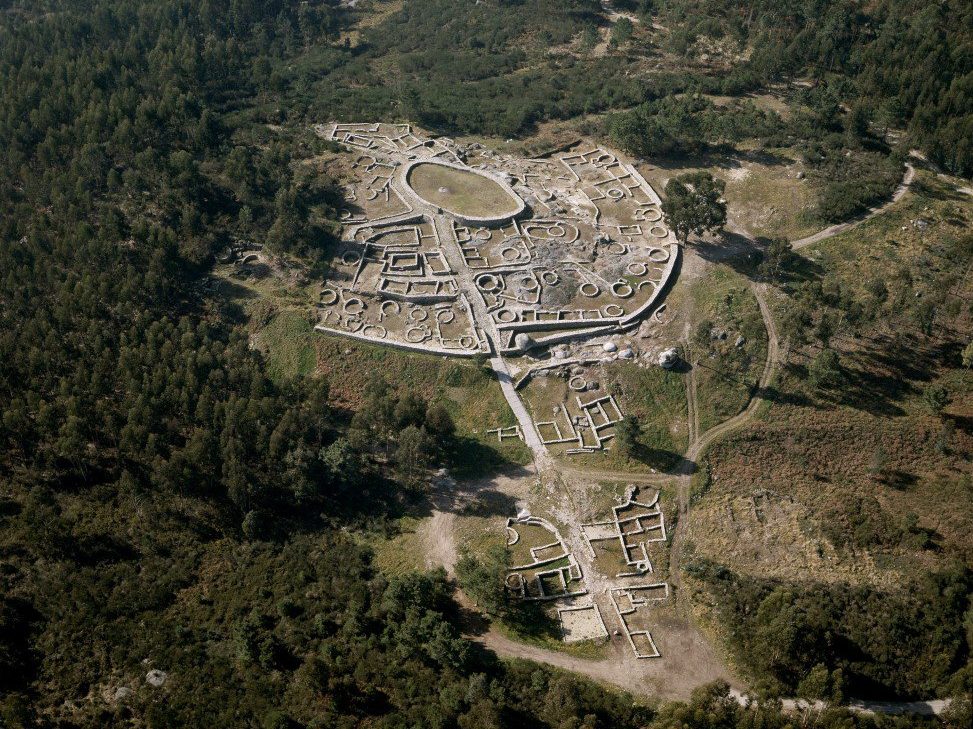
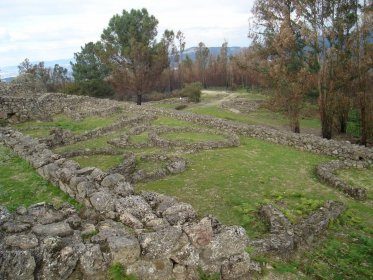
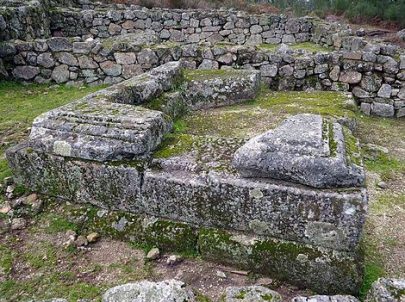
The Castro de Monte Mozinho is a Neolithic walled town, also known as the City of the Dead, located in the civil parish of Oldrões, municipality of Penafiel in the Tâmega Subregion district of Porto.
Monte Mozinho is a fortified settlement with three lines of walls, perched on a hill and covering an area of more than 200.000 m2. Its urban architecture mixes the heritage of hill forts with Roman civilization, as seen by the courtyard homes with circular forms and foyers and the regular street arrangement. This settlement was occupied for a rather lengthy period of time, between the first and fifth centuries.
This is one of the celtic settlements named Citânia do Monte Mozinho, located approximately 8 kilometres from Penafiel. It is perhaps the largest in the Iberian Peninsula. It is located at a high point on the mountain, at an elevation of 408 metres. From there, one can see the Maro Mountain (to the east) and the Montemuro Mountain (to the west) (to the South). The excavations began in 1943 by Elsio Ferreira. After a 20-year hiatus, they resumed in 1974, and the results may be seen in the Municipal Museum of Penafiel. The discoveries corroborate the presence of a Roman-era occupancy, with a specific emphasis on the warrior statues and amphorae. The “castro” was erected in 19 BC, after the Roman invasion was completed, and formerly had a 20-ha walled area. The settlement was gradually abandoned and lost its prominence after the second century AD.
The town of Portalegre is a wonderful place to visit. Stunning views from a fortified hilltop town provide spectacular views of the surrounding countryside, and a good dose of prehistoric wealth can be found across the region. During the sweltering summer months in the Portuguese interior, a spate of dams (barragem) provide the ideal backdrop for water activities and a cooling plunge for the active or overheated.
Things to see and do in Portalegre
Portalegre is located near the Spanish border on the green slopes of the São Mamede mountains, which has been converted into a national park with defined walking trails and an abundance of varied animals ranging from wild boar and red deer to vultures and eagles.
The top of São Mamede, at over 3000 feet, is a short drive away along a winding route with magnificent views.
The town’s substantial defences have seen much combat, withstanding a five-month siege by Dom Dinis in the 13th century and several others afterwards. During the early 1800s Peninsular War, British troops on the Portuguese side were stationed here.
Museu Municipal de Portalegre
The town’s municipal museum is housed in a stunning 16th-century structure that was formerly the diocesan seminary. It was acquired by a local lord in the 18th century and remodelled into a magnificent house, and this is the layout that remains today.
The museum’s collection is mostly comprised of liturgical art culled from the town’s two dissolved convents, Santa Clara and So Bernardo, and some of these pieces are outstanding.
There is an Indo-Portuguese ivory sculpture of the Virgin Mary, a Japanese missal stand from the 1500s, and a 1500s altarpiece with polychrome clay bible passages.
The remainder of the collection includes silver snuffboxes, exquisite faience, and furnishings.
Portalegre Cathedral
The town’s cathedral is a National Monument; it was built in the 16th century on the site of an ancient mediaeval church by King John III.
It dominates Portalegre from its apex and, combined with its bishop palace, forms an imposing Mannerist ensemble.
The interior’s current look dates from the late 18th century when it was given a Neoclassical makeover, but there are also remnants of the 16th and 17th centuries. The white marble pulpits and 96 painted panels from the 1500s and 1600s are particularly noteworthy.
Convento de São Bernardo
Perhaps the most photographed feature in Portalegre is the ochre and white walls of this monastery, as well as the cobblestone square and fountain in front.
The convent was established in the 1500s to shelter “maidens without dowry.” There is a mixture of architecture from many eras, but the highlights are from the 1500s and were completed by French sculptor Nicolas de Chantereine.
He sculpted the marble pulpit with its grotesques, as well as the magnificent tomb of the convent’s founder, Bishop Jorge de Melo.
Additionally, there is a quiet cloister with arcades lined with blue and white panels.
Museu da Tapeçaria de Portalegre
Since the Middle Ages, weaving has been a traditional craft in Portalegre, but in the 1940s, entrepreneur Guy Fino and weaver Manuel do Celestino Peixeiro developed a new tapestry-making process.
This is known as Ponto de Portalegre, and while it was inspired in part by Roubaix tapestries, it has its unique style.
Portalegre quickly developed a reputation for creativity and workmanship, rivalling those of Flanders and France.
All of this history is detailed on the bottom floor of this museum, illustrating the origins and practises of the Portalegre Manufactory. Upstairs, specimens of this art form are shown, introducing some of the town’s accomplished weavers over the previous 70 years.
Portalegre
Portalegre’s castle is located in the city’s oldest section and rises above a labyrinth of small lanes. It fell under siege several times throughout the 13th and 14th century’ dynastic crisis and civil wars. Little remains, save for a section of the keep where a contemporary wood and glass frame has been constructed to assist with navigating. The surrounding streets are quiet yet worth exploring for their beautifully dishevelled whitewashed buildings with vibrant trim. Additionally, five of the city’s original seven gates have survived, the most photogenic of which is the 13th-century Porta de Alegrete. Additionally, in Praça da Repblica, visit the Palacio Achaioli, an 18th-century mansion that has been turned into a university.
Roman Ruins of Ammaia
The remnants of a Roman settlement having 2,000 people are located in the São Mamede Natural Park, which borders Portalegre. Outside, there is much to see, including the city’s gateway, remnants of the forum and temple, a huge mansion (called the Quinta do Deão), and thermal baths. Many of these relics were discovered just lately since the site was first excavated in the 1990s.
Numerous artefacts were discovered, particularly around the baths, and a large number have been donated to the National Museum of Archaeology in Lisbon. However, the location features a charming small museum with a film presentation and displays of jewellery, kitchenware, pottery, and blown glass.
Convento de Santa Clara
This 14th-century convent, which is currently home to the city’s library, is another of Portalegre’s National Monuments. That does not diminish its importance, since you must enter to marvel at the Gothic cloister. This was constructed during King Fernando I’s (16-year reign) and is considered to be Portugal’s sole surviving cloister from that era. It is surrounded by two layers of galleries, while the tranquil garden is on the ground level. In the centre is a 1500s marble fountain.
Serra de São Mamede Natural Park
Intrepid spirits will be eager to climb the chain of quartzite mountains that surrounds the city to the north and west.
This region is some of the wildest in western Europe, providing a home for endangered species such as genets, Iberian lynxes, and Iberian wolves, as well as bats, wild boar, and hundreds of deer.
There are cork oak, eucalyptus, pine, and sweet chestnut woods to explore on foot or by bicycle, as well as evidence of prehistoric civilizations in the form of megaliths and rock art. You may have your sights set on the Serra de São Mamede, the highest peak in the range, which rises to a little over 1,000 metres. From the peak, views extend into Spain and as far north as the Serra da Estrela in Portugal, 150 kilometres to the north.
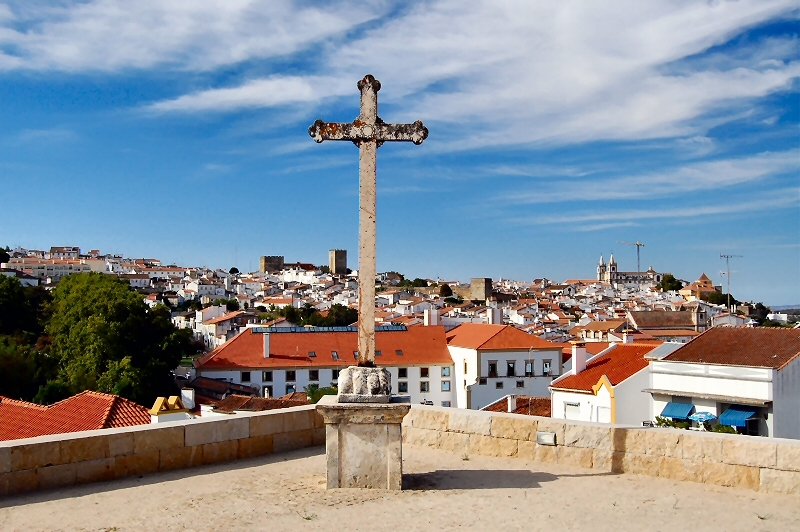
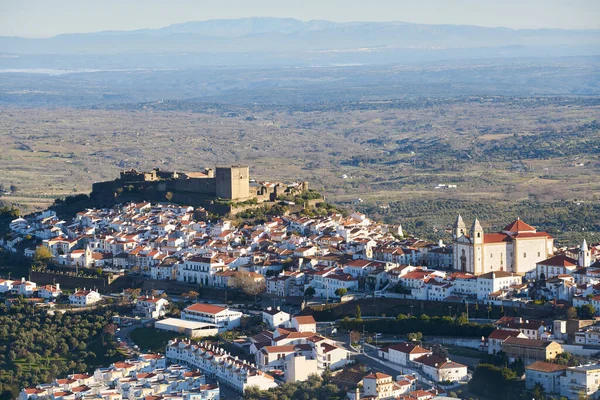
Castelo de Vide is a village located in northern Alentejo at the foot of a double hill dominated by a 13th-century castle built by D. Dinis and the Fortress of São Roque. Within the stronghold is a church with the same name. Between the 18th and 19th centuries, the Igreja de Santa Maria Devesa Church was constructed between the fortification and the castle.
This village does not have many landmarks, yet it is a wonderful place for a day trip or an overnight stay. The location is especially beautiful during sunrise and sunset. The castle is accessible via the steep lanes of the renowned “Gothic Quarter,” which is lined with buildings with Gothic gateways and large windows. Next to the castle are the Megalithic Center and the Military History and Architecture Museum. Following the expulsion of Jews from Spain in the 15th century, a little Judiaria (Jewish neighbourhood) reached its height. This is evidenced by the tiny synagogue, which is now a museum.
The Fonte da Vila, a 16th-century marble fountain that has deteriorated with time, is located east of the Judiaria. This fountain offers great-tasting mineral water, which is also available at other public fountains. This wonderful water made Castelo de Vide famous. At the Castelo de Vide Cultural Center, there are many temporary displays that change throughout the year. Numerous megaliths are dispersed around the region, with the Coureleiros Anta (8 kilometres north of the city) and Menhir da Meada (8.5 kilometres beyond) being the most remarkable. Easter week is a beautiful time to visit Castelo de Vide. It’s one of the longest-running community celebrations that is usually teeming with activity. Every year, from April to March, the festival lasts four days and features dances and processions.
Portugal is a great destination for adventurous visitors thanks to its moderate temperature and affordable cost of living. Portugal is divided into seven regions, and each one has its own special brand of adrenaline-pumping excitement.
Trekking in northern Portugal
The city of Porto in northern Portugal is well-known for its port wine, but the region as a whole should be lauded for its diverse scenery. Off-road enthusiasts will enjoy Peneda-Geres Park. Also, it’s the only protected region designated as a National Park by the Portuguese government. Set off on foot from Campo do Geres, which is situated between the Cavado and Homem rivers. Use a Jeep to get to the trailhead. You’ll pass the Lindoso Dam on the route. Vilarinho das Furnas, a village that dates back to the 1st century and was flooded in the 1970s to make room for the dam, can be seen when the reservoir is low. Northwest of Serra do Geres, in the settlement of Pitoes das Junias, you’ll find a 9th-century Benedictine abbey cut by streams and waterfalls.
Canoeing in the Tras-os-Montes
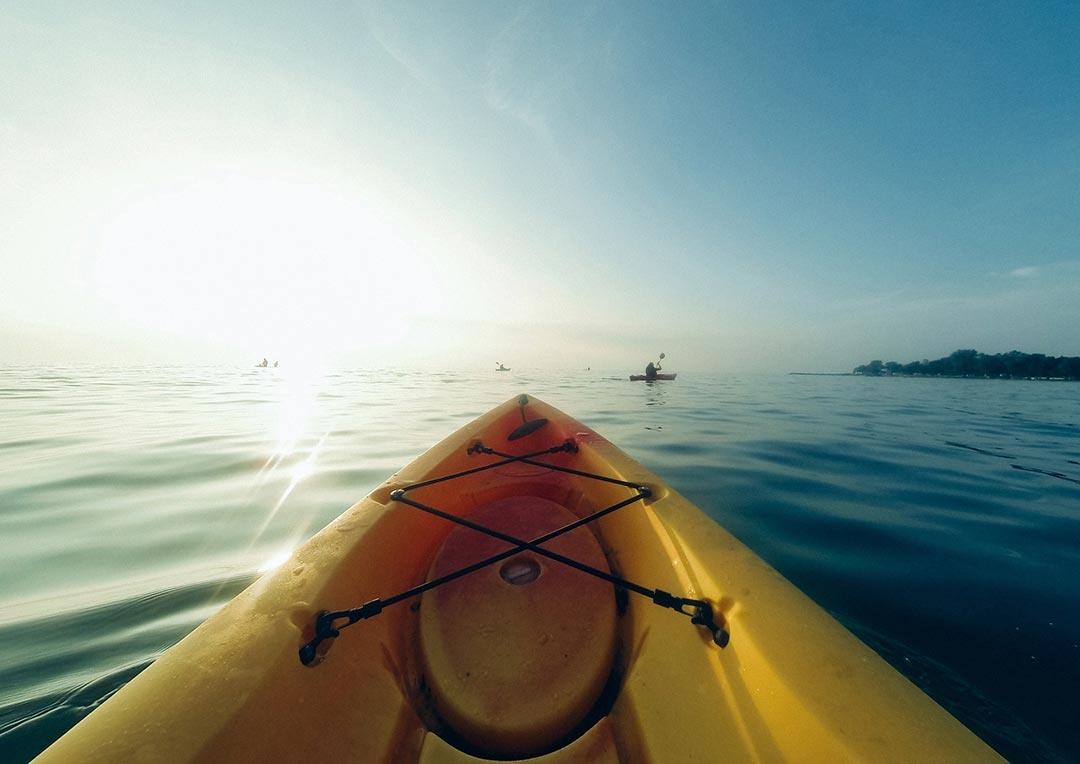
In the Tras-os-Montes region’s mountains, visitors may enjoy a day of canoeing in the deep river valleys and rivers. The Sabor and Tua rivers are excellent for afternoon floats. While navigating over mild rapids, you will see vineyards, old cedar woods, and quaint villages. On very hot days, you may want to take a dip before returning to your car.
Cycling in the Douro Valley
Stunning terraced hills and vineyards provide the perfect background for a scenic—and challenging—bike ride through the country’s best wine area. The roads in this area are pleasantly quiet, and the way they undulate between the vineyards and valleys makes cycling journeys across the Douro valley surprisingly easy for inexperienced riders to accomplish.
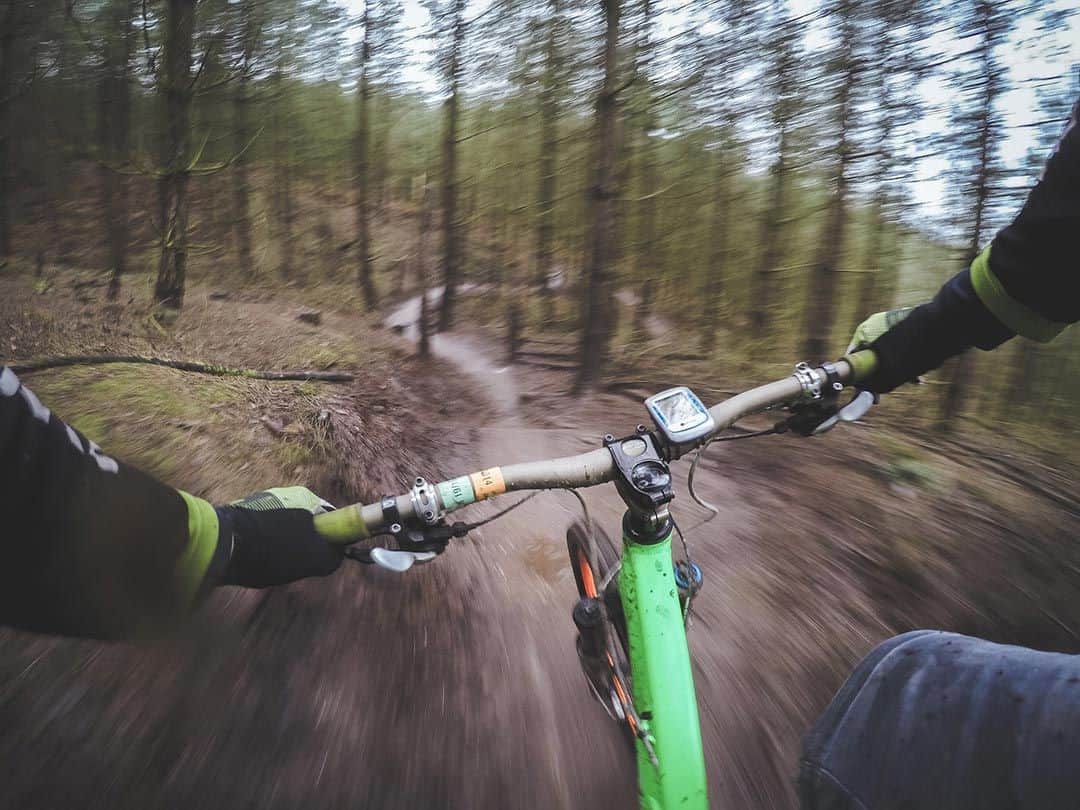
Mountain Biking In The Lousã Mountains
The schist pathways and bike tracks that snake through the Lousã Mountains near Coimbra will delight avid riders.
If you feel hungry, stop by one of the 27 villages that dot the hills — the friendly people are always willing to offer up the traditional fare (or to sell you handmade crafts).
Climbing in the Beiras Region
The Torre mountain range, which rises out of Central Portugal at a height of 6,539 feet, is the highest point in the country, and it may be reached by travelling south from Porto. Rock climbers and hikers will encounter some severe climbing obstacles in this area (think: rappelling down through ghost villages of the Lousa Mountains). The borderlands between Gaura and Castelo Branco are dotted with abandoned trade routes that wind their way through granite hills, historic towns, and flowing rivers.
Surfing The World’s Best Waves
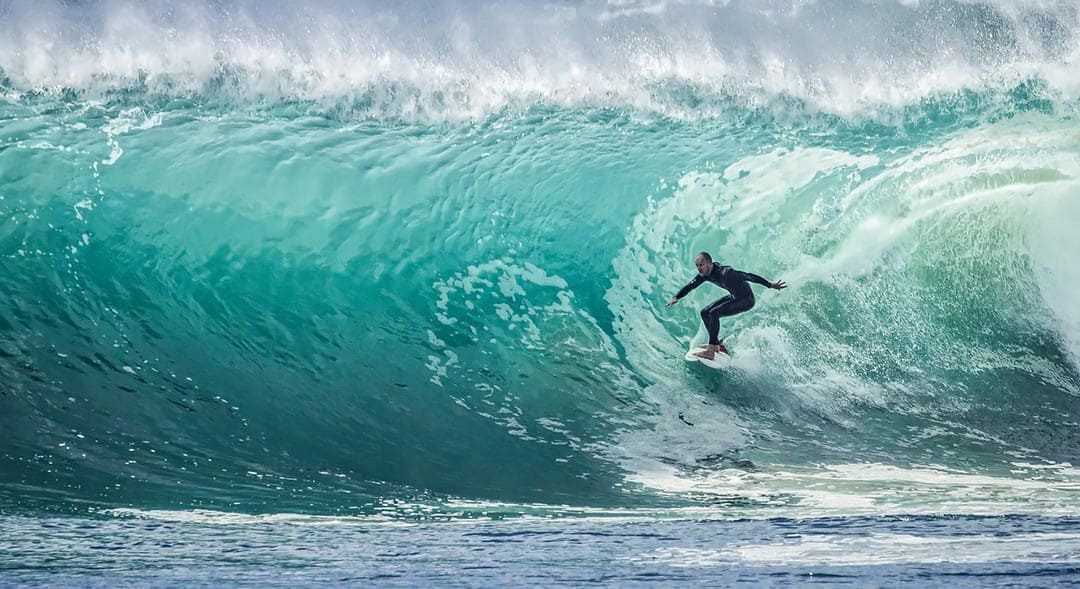
Portugal, without a doubt, offers some of Europe’s greatest surfing waves, from the spectacular North Canyon in Nazaré (where Garrett McNamara set the Guinness World Record for surfing the world’s largest wave) to Peniche’s Supertubos (home to the Rip Curl Pro competition).
Coxos, near Ericeira, has to be the best wave in Portugal – a right-hand barrel that crashes over flat rocks.
Ericeira has been designated a World Surf Reserve, confirming its reputation as one of the world’s greatest surf locations. There are nine world-class surf breakers and thirty great surf locations within driving distance.
While the Portuguese city, Lisbon, is initially thought of as a cultural (and gourmet) destination, it also has a lot to offer explorers and travellers. The beaches in and around Lisbon border the Atlantic Ocean and have been a favourite destination for water enthusiasts for decades, with beaches such as Carcavelos being particularly popular with bodyboarders, surfers, and kite surfers among others. Guincho beach, located a short distance outside of the city and nestled between Sintra and the Cascais National Park, is a popular venue for European championship windsurfing and surfing competitions. You may rent both boards and lessons at this location. Praia Grande, located on the coast of Sintra, is well-known for its water sports activities.
Horseback Riding in the Alentejo Region
Once you leave Lisbon and enter the Alentejo Region, the terrain opens out to expansive fields that are ideal for equestrian rides in the surrounding countryside. Equestrians may ride along scenic rural routes that are well-maintained. Take your horse for a canter over sand dunes, eucalyptus trees, and rice fields on the Alentejo Coast Trail in the springtime, when you’ll have lots of possibilities to gallop through the huge terrain. Alentejo also has a number of riding schools, such as the Alter do Chao stud farm, where visitors may see imperial Lusitanian horses in their natural habitat.
Hang Glide Over the Algarve
The beaches of the Algarve are unquestionably beautiful, and they are much more so when viewed from above. Travellers may take advantage of a once-in-a-lifetime opportunity to hang glide over the Atlantic while travelling along the windswept Costa Vicentina. There are carob and almond trees in the Barrocal region, as well as orchards and tiny vineyards, all of which may be seen in the scenery below. When visiting this region of the country, consider taking a hot air balloon flight.
Coasteering In Sagres
The Algarve coast’s steep cliffs, hidden beaches, and magnificent sea caves were created for coasteering – an adventure sport that requires leaping, swimming and climbing.
The greatest spot to sample it is on the western Algarve’s coast between Lagos and Sagres, in the Natural Park of Costa Vicentina.
Climbing the orange cliff sides is enjoyable in and of itself, but when combined with swimming in the crystal clear waters and finding secret grottos, this is one of the finest ways to explore Portugal’s natural beauty.
If you’ve never gone coasteering before, it’s better to go with a local tour leader who will know exactly when the tides come in and out and where the safest places to jump and swim are.
Swimming in Madeira
Madeira is a Portuguese archipelago located in the Atlantic Ocean off the country’s southwest coast. It is a year-round vacation destination renowned for its wine, cuisine, and culture. However, diving directly into the surrounding seas is one of the finest ways to get a sense of Madeira. Its volcanic mountains soar to almost 4,000 feet and then drop to the sea in tremendous cascades of streams. Summer is an excellent time for streams on the northern slopes, with a stronger and more powerful water flow. The southern slopes are milder in the winter, with moderate currents. Porto Santo’s 5.5-mile-long coastline is ideal for diving and snorkelling. Take a look at the sunken ships south of Porto de Abrigo.
Whale-watching in the Azores
The Azores Islands of Portugal—an archipelago of nine volcanic islands located in the Atlantic around 850 miles west of Portugal—are home to some magnificent animals. Whale viewing is excellent here since more than 20 species of cetaceans (including sperm whales, northern bottlenose whales, pilot whales, sowerby’s beaked whales, and the rare orca) travel through Portugal or make the Azores home throughout their migrations. Whale-watching trips are offered all year, though the weather is most pleasant (and the whales are most plentiful) during the warm summer months.
We use cookies on our website to give you the most relevant experience by remembering your preferences and repeat visits. By clicking “Accept All”, you consent to the use of ALL the cookies. However, you may visit "Cookie Settings" to provide a controlled consent.
This website uses cookies to improve your experience while you navigate through the website. Out of these, the cookies that are categorized as necessary are stored on your browser as they are essential for the working of basic functionalities of the website. We also use third-party cookies that help us analyze and understand how you use this website. These cookies will be stored in your browser only with your consent. You also have the option to opt-out of these cookies. But opting out of some of these cookies may affect your browsing experience.
Necessary cookies are absolutely essential for the website to function properly. These cookies ensure basic functionalities and security features of the website, anonymously.
Cookie
Duration
Description
cookielawinfo-checkbox-analytics
11 months
This cookie is set by GDPR Cookie Consent plugin. The cookie is used to store the user consent for the cookies in the category "Analytics".
cookielawinfo-checkbox-functional
11 months
The cookie is set by GDPR cookie consent to record the user consent for the cookies in the category "Functional".
cookielawinfo-checkbox-necessary
11 months
This cookie is set by GDPR Cookie Consent plugin. The cookies is used to store the user consent for the cookies in the category "Necessary".
cookielawinfo-checkbox-others
11 months
This cookie is set by GDPR Cookie Consent plugin. The cookie is used to store the user consent for the cookies in the category "Other.
cookielawinfo-checkbox-performance
11 months
This cookie is set by GDPR Cookie Consent plugin. The cookie is used to store the user consent for the cookies in the category "Performance".
viewed_cookie_policy
11 months
The cookie is set by the GDPR Cookie Consent plugin and is used to store whether or not user has consented to the use of cookies. It does not store any personal data.
Functional cookies help to perform certain functionalities like sharing the content of the website on social media platforms, collect feedbacks, and other third-party features.
Performance cookies are used to understand and analyze the key performance indexes of the website which helps in delivering a better user experience for the visitors.
Analytical cookies are used to understand how visitors interact with the website. These cookies help provide information on metrics the number of visitors, bounce rate, traffic source, etc.
Advertisement cookies are used to provide visitors with relevant ads and marketing campaigns. These cookies track visitors across websites and collect information to provide customized ads.















 The Fonte da Vila, a 16th-century marble fountain that has deteriorated with time, is located east of the Judiaria. This fountain offers great-tasting mineral water, which is also available at other public fountains. This wonderful water made Castelo de Vide famous.